
The U.S. Wants to Return to the Moon and Build a Base There During Donald Trump’s Presidency
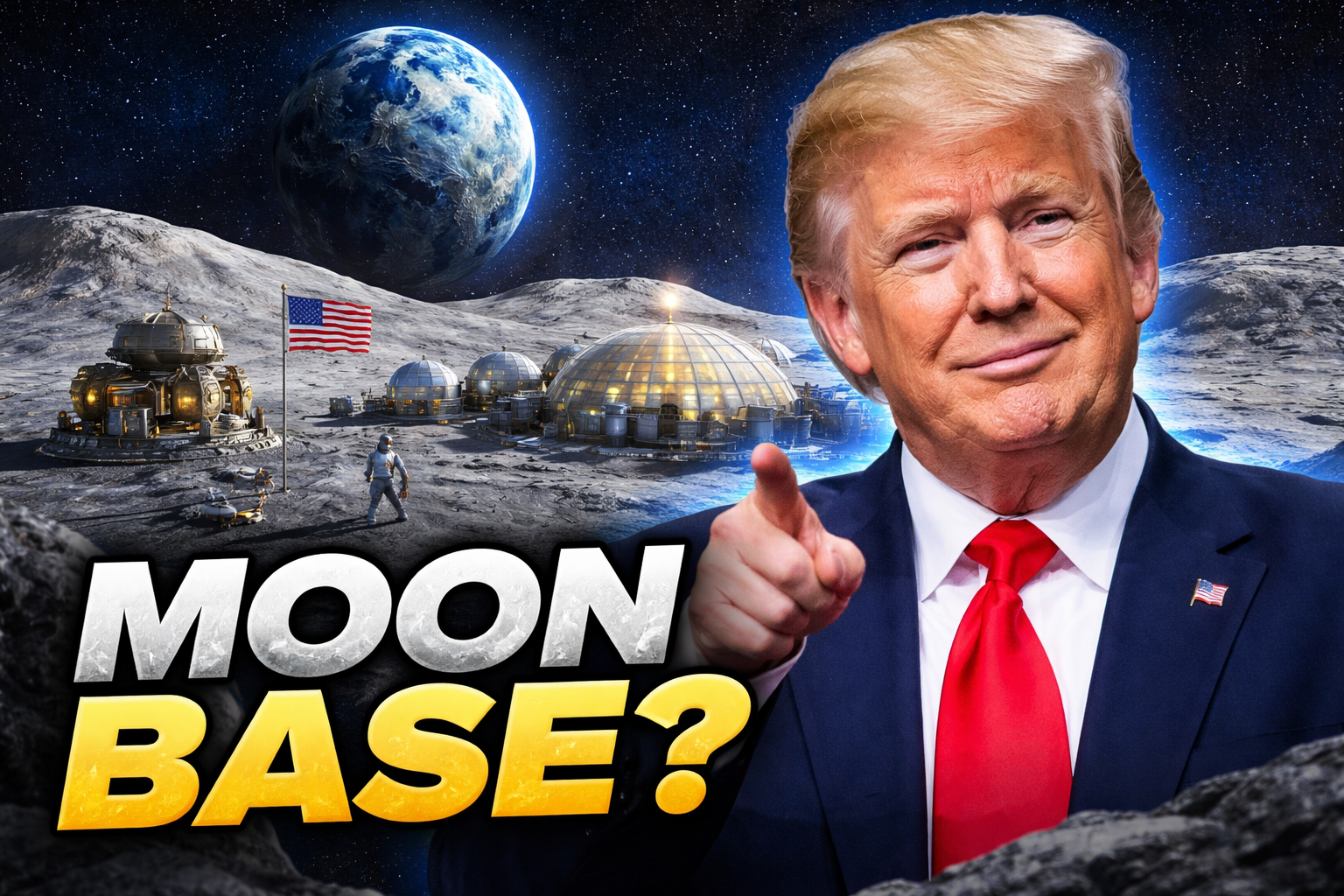
The United States is no longer speaking about the Moon as if it is only a nostalgic destination from the Apollo era.
The language has changed.
The ambition has changed.
And the political framing has changed too.
What is now being discussed is not just another symbolic mission where astronauts land, plant a flag, collect a few samples, and return home. The vision has become much bigger than that. The U.S. is increasingly talking about returning to the Moon, doing it at a higher frequency, and eventually creating the foundation for a lasting American presence there.
That is what makes this topic important.
This is not only a space headline.
It is a long-term strategy story.
It is a technology story.
It is an infrastructure story.
And it is also a geopolitical story.
Under Donald Trump’s presidency, the idea of going back to the Moon is being framed in a more direct and ambitious way. The emphasis is not just on exploration. It is on presence. It is on continuity. It is on building something that can last beyond a single landing or a single photo moment.
That changes the meaning of the mission.
This is not just about “going back”
For years, many people heard about NASA’s Artemis program as the successor to Apollo.
That basic description is true, but it is also too small.
Artemis is not being presented as a simple repeat of what America already did in the 1960s and 1970s. It is being positioned as the beginning of a longer phase of human activity around and on the Moon. That means the Moon is no longer being treated only as a destination. It is being treated more like a platform.
That distinction matters a lot.
In the Apollo era, the Moon was a proving ground. The United States wanted to demonstrate technological power, beat the Soviet Union in the space race, and achieve one of the most dramatic milestones in human history. Once that objective was achieved, the long-term infrastructure side was never seriously built out.
The current vision appears different.
Now the Moon is being described as a place where humans may return repeatedly, stay for longer periods, build systems that support continued operations, test technologies for life beyond Earth, and prepare for even more ambitious future missions, including missions to Mars.
That is a completely different mindset from the old one.
It is the difference between a visit and a foothold.
Why the Moon matters again
Some people might ask a simple question: why the Moon again?
That is a fair question.
The Moon can seem old compared with all the newer conversations about Mars, artificial intelligence, reusable rockets, satellites, and private space companies. But in reality, the Moon is becoming important again precisely because it sits at the center of many of those bigger ambitions.
The Moon matters because it is close enough to reach with existing and near-future human space systems, but harsh enough to serve as a meaningful test environment. It allows the United States to experiment with long-duration living systems, power generation, communications, robotics, autonomous operations, surface transport, excavation, and the use of local materials in a hostile environment.
In simple terms, the Moon is the nearest place where humanity can start learning how to build something real beyond Earth.
That makes it extremely valuable.
If the U.S. wants to become a civilization that eventually operates beyond low Earth orbit in a more permanent way, the Moon is the most logical next step.
It is not the final goal.
But it may be the most important next base of experience.
What the current U.S. direction appears to be
The key thing to understand is that the current vision appears to involve multiple stages.
The first stage is returning astronauts to the Moon.
The second stage is increasing regularity and mission cadence.
The third stage is beginning to establish the early components of a longer-term lunar outpost or base.
That sequence is important because it shows this is not being framed as a one-off stunt. It is being framed as a progression.
The return to the Moon is not being sold only as an ending in itself. It is being sold as the beginning of something larger.
And that is exactly why people are now discussing a Moon base more seriously.
Once policymakers, NASA leadership, and White House communications begin talking not only about landing but about enduring presence, annual missions, and long-term infrastructure, the conversation moves into a different category. It stops being purely inspirational and starts becoming operational.
That does not mean everything will happen exactly on schedule.
Space programs rarely move without delays, technical surprises, funding pressures, political changes, or contractor issues.
But the direction of travel still matters.
And right now, that direction appears clear: America wants to get back to the Moon and begin laying the foundation for staying there longer.
The Moon base idea is bigger than the headline
When most people hear the phrase “Moon base,” they imagine a giant science-fiction structure with domes, long corridors, large crews, and a highly developed settlement.
That is probably not the right way to think about the first phase.
A real Moon base would almost certainly begin in a much smaller and more practical form.
It would likely start with initial elements rather than a full finished base. That could include surface habitats, power systems, communication systems, mobility systems such as rovers, cargo support capability, and equipment that allows astronauts and robotic systems to function more effectively over repeated missions.
In other words, the first version of a Moon base may not look dramatic to the public.
It may look technical.
Incremental.
Unfinished.
But that is how real infrastructure usually begins.
The biggest misunderstanding people often have is that a base only counts once it looks large and permanent. In reality, the earliest elements are often the most important. Once there is enough hardware, support capacity, mission rhythm, and planning continuity on the lunar surface, the base concept becomes real even before it looks visually impressive.
That is why phrases like “initial elements of a permanent lunar outpost” matter so much.
They suggest that the U.S. goal is not just another heroic landing, but the beginning of staged infrastructure.
Is the goal to build it during Trump’s presidency?
This is where the topic needs precision.
There is a difference between saying the United States wants to return to the Moon during Donald Trump’s presidency and saying the full Moon base will be completed during his term.
Those are not the same claim.
The stronger and more accurate version is this:
The U.S. wants to return to the Moon during Trump’s presidency and use that period to accelerate the path toward a lunar base.
That is a much better way to frame it.
It leaves room for the fact that real space infrastructure takes time. Even if the administration pushes aggressively, a permanent or semi-permanent lunar outpost is not likely to appear overnight. It would come through phases: return missions, cargo missions, system testing, hardware deployment, and gradually more capable surface operations.
So yes, the ambition is real.
Yes, the base concept is part of the direction.
But no, that does not necessarily mean a fully developed base would be completed before the end of one presidential term.
The Moon base story is bigger than a single presidency, even if one presidency helps accelerate it.
Why this matters politically
The Moon is not only being framed as a science project.
It is also being framed as a symbol of national strength, technological leadership, and long-term strategic ambition.
That matters because in modern politics, space is no longer just about discovery.
It is about competition.
It is about industrial capacity.
It is about innovation.
It is about national prestige.
And increasingly, it is also about security and influence.
A country that can repeatedly send humans to the Moon, support them there, generate power there, deploy equipment there, and eventually expand operations there is demonstrating much more than scientific curiosity. It is demonstrating advanced national capability across engineering, manufacturing, logistics, computing, communications, robotics, energy systems, and aerospace coordination.
That is one reason the lunar discussion has become more serious.
The Moon is not being framed merely as a beautiful destination in the night sky.
It is being framed more like strategic terrain.
That does not mean it becomes military in the simplistic way some people imagine. But it does mean governments are thinking beyond symbolism. They are thinking about long-term positioning.
Why this matters technologically
The Moon base concept is also a story about technology maturity.
A sustained lunar presence would force progress in several critical areas at once:
life support systems
surface habitats
energy generation
radiation protection
autonomous robotics
lunar mobility systems
communications networks
precision landing systems
cargo logistics
resource-use experiments
That is what makes lunar ambitions so significant.
Even if the base itself remains modest at first, the process of trying to build it can accelerate a huge number of technologies that later matter elsewhere too.
A lunar program is not just about the Moon.
It can influence Earth industries, defense technologies, robotics, energy systems, remote operations, and eventually Mars architecture.
This is why the Moon often becomes the place where multiple future technologies meet.
It is hard enough to demand innovation, but close enough to make repeated testing possible.
The private-sector angle
Another important part of this story is that the Moon return effort is not happening in a world dominated only by old-style government space programs.
This time, private aerospace companies are much more important than they were during Apollo.
That changes the structure of the mission.
The U.S. approach now involves a deeper relationship between government and commercial space companies. Launch systems, landers, support systems, logistics, and surface technologies are increasingly shaped through that partnership model.
That can speed things up in some ways.
It can also create new risks and dependencies in others.
But overall, it means the modern Moon effort is not just a national prestige project run in isolation. It is also tied to commercial ecosystems, contract structures, competitive supplier networks, and a growing broader space economy.
That makes the story larger than NASA alone.
The international angle
Another reason this matters is that the Moon is becoming part of alliance-building and international cooperation.
Once governments start speaking openly about long-term lunar presence, they also begin weaving that vision into diplomatic relationships. Partner countries may contribute technology, mobility systems, scientific support, logistics capability, or mission collaboration.
That matters because it turns the lunar effort into more than an American domestic project.
It becomes part of a larger coalition-building strategy.
And that has real implications.
The country that leads a long-term lunar architecture may also shape standards, partnerships, and expectations for future deep-space activity. In that sense, the Moon is not just about hardware on the surface. It is also about leadership in setting the direction of the next era of space activity.
Why the timeline still needs caution
Even though the ambition is real, it is still important not to write the story in a way that sounds too certain or too immediate.
Space timelines slip all the time.
Programs get delayed.
Costs rise.
Political priorities shift.
Hardware fails tests.
Mission architectures evolve.
Presidents change.
Congress changes.
Contractors miss milestones.
This does not mean the project is fake.
It just means large space programs are difficult.
So the strongest article framing is not that America will definitely have a fully built Moon base by a specific near-term date no matter what. The stronger framing is that the official direction clearly points toward returning to the Moon and beginning the path toward a base or long-term outpost.
That version is both ambitious and credible.
My take
The most important part of this story is not that America wants another Moon landing.
It is that America appears to be thinking in terms of presence again.
That is the real shift.
A single landing is dramatic, but temporary.
A long-term lunar presence is something else entirely.
It means the U.S. is thinking less like a visitor and more like a builder.
That does not guarantee success.
It does not guarantee schedules will hold.
And it does not guarantee the political momentum will stay equally strong for years.
But it does show that the strategic mindset has changed.
And that alone is a major development.
Once a country starts talking about repeated landings, lunar systems, surface power, and the early elements of a permanent outpost, it has moved beyond symbolic exploration. It is now talking about infrastructure beyond Earth.
That is a historic threshold if it actually continues.
Final thoughts
Yes, the United States wants to return to the Moon during Donald Trump’s presidency.
And yes, the broader ambition appears to include moving toward a Moon base or permanent lunar outpost.
But the cleanest and most accurate way to understand the situation is this:
The U.S. wants to use this period to restart human lunar operations and begin laying the groundwork for a more enduring American presence on the Moon.
That makes this much more than a one-mission story.
It is a story about infrastructure, influence, technology, and long-term ambition.
It is also a reminder that the future of space may not be defined only by who lands somewhere first.
It may be defined by who can keep showing up, keep building, and keep expanding what is possible.