
The B-2 Spirit, F-22 Raptor, and F-35 Lightning II: How America’s Top Combat Aircraft Were Built, What Makes Them Special, and How Far Ahead They Still Are
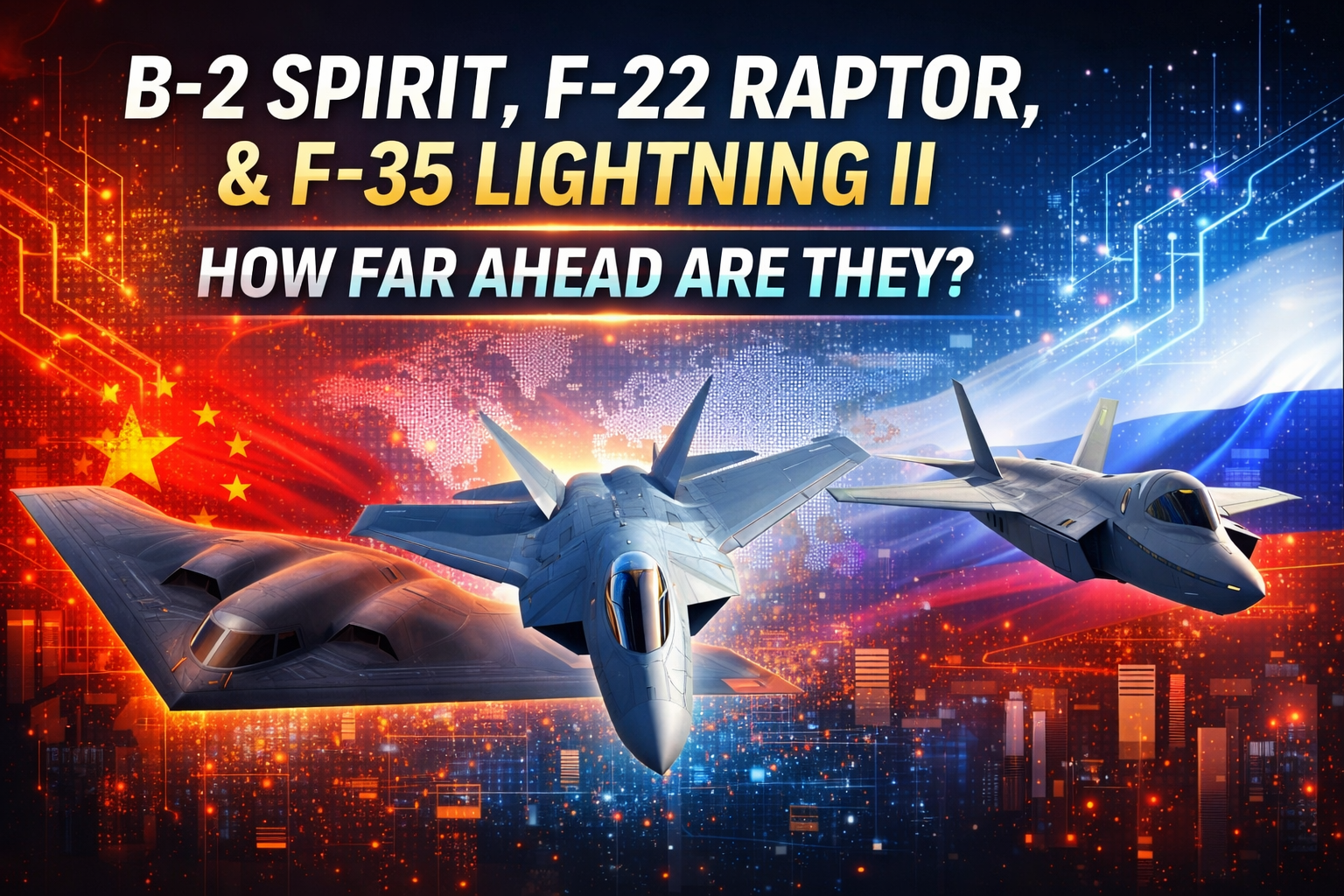
First, one important correction: the B-2 Spirit, F-22 Raptor, and F-35 are not U.S. Army aircraft. They are primarily U.S. Air Force aircraft, and the F-35 is also a joint family used by the U.S. Marine Corps, U.S. Navy, and a growing list of allies. The Army does not operate these jets.
When people talk about the most advanced American combat aircraft, these three come up for different reasons. The B-2 represents stealthy long-range strike. The F-22 represents high-end air dominance. The F-35 represents stealth fused with sensors, software, and coalition-scale networking. They are all “advanced,” but they are not advanced in the same way, and that distinction matters when you compare them to Chinese and Russian competitors.
The cleanest way to understand them is this: the B-2 was built to penetrate dense air defenses and hit strategic targets; the F-22 was built to beat the best enemy fighters in contested airspace; and the F-35 was built to connect stealth, sensing, data fusion, and multirole flexibility at scale. That is why these aircraft still sit at the center of U.S. airpower discussions decades after their development began.
Why these three aircraft matter so much
These aircraft matter because they reflect three different layers of military advantage. One layer is survivable reach - the ability to strike deep targets even when defenses are strong. That is the B-2’s world. Another layer is air superiority - the ability to win the battle in the sky against advanced fighters and clear the way for the rest of the force. That is where the F-22 was designed to dominate. The third layer is information advantage - knowing more, sharing more, and acting faster across a joint and allied force. That is where the F-35 has become especially important.
This is also why comparing them as if they are just “three cool stealth aircraft” misses the point. The B-2 is not an F-22 with a bigger body. The F-22 is not an F-35 with fewer international users. Each one was built around a different military problem, and each one still has strengths that are hard for competitors to match in exactly the same package.
The timeline: when development started and when they were actually “released”
The word “released” can mean a few different things with military aircraft. It can mean when development started, when the aircraft was publicly unveiled, when it first flew, when the first operational aircraft was delivered, or when the aircraft reached initial operational capability. For this topic, the most useful timeline is to show all of those major milestones.
For the B-2 Spirit, development began in 1981. The public first saw it on Nov. 22, 1988. Its first flight was on July 17, 1989. The first operational B-2 was delivered on Dec. 17, 1993, and GAO reported that the B-2 achieved initial operational capability on April 1, 1997.
For the F-22 Raptor, the roots of the program go back to the Air Force’s Advanced Tactical Fighter effort in the early 1980s, with the program clearly in motion by 1981 and in the Demonstration and Validation phase by 1986. Lockheed’s design won the competition in 1991. The F-22 first flew on Sept. 7, 1997. The first combat-capable Raptor was delivered to Langley on May 12, 2005, and the Air Force lists initial operational capability as December 2005.
For the F-35 Lightning II, the broader Joint Strike Fighter competition began in November 1996, while the formal system development phase entered in October 2001. The F-35 first flew on Dec. 15, 2006. The U.S. Marine Corps declared IOC for the F-35B in July 2015, the U.S. Air Force declared IOC for the F-35A on Aug. 2, 2016, and the Navy declared IOC for the F-35C in February 2019. If you want the version most relevant to the Air Force, the key “release into service” date is 2016 for the F-35A.
So if someone asks in a simplified way, “When were they developed and released?” the short version is: B-2: 1981 / operational in the 1990s, F-22: early 1980s / operational in 2005, F-35: late 1990s to 2001 start / operational from 2015-2016 onward depending on variant.
The B-2 Spirit: why it was revolutionary
The B-2 was revolutionary because it combined strategic bomber range, heavy payload, and deep stealth penetration in a way no operational bomber had done before. The Air Force says its unrefueled range is about 6,000 nautical miles, and its low observability comes from a combination of reduced infrared, acoustic, electromagnetic, visual, and radar signatures. In simple language, the B-2 was built to get through defenses that would make older bombers far easier to detect and engage.
Its flying-wing design was not just a visual signature. It was part of the overall low-observable philosophy. The B-2 was intended to bring large payloads over intercontinental distances and still retain the ability to penetrate sophisticated defenses, which is why it became such an important part of both the conventional and nuclear strike posture. The Air Force still describes it as a bomber capable of delivering both conventional and nuclear munitions.
The B-2 also mattered strategically because it reduced the need for enormous support packages. Older non-stealth bombers often depend much more heavily on jammers, escorts, and route planning around enemy defenses. The B-2 changed the equation by making stealth itself a central part of survivability. That did not make it invincible, but it dramatically changed how the U.S. could think about penetrating strikes.
In public military history, the B-2 quickly proved that it was not just a Cold War science project. The National Museum of the U.S. Air Force notes that it later demonstrated combat capability in Operation Allied Force over Serbia in 1999, Operation Enduring Freedom over Afghanistan in 2001, and Operation Iraqi Freedom over Iraq in 2003. That operational record matters because it shows the aircraft transitioned from a classified technological symbol into a real combat asset.
The B-2’s specialty
The B-2’s real specialty is stealthy long-range penetration strike. It is designed to travel far, carry serious payload, and attack high-value targets inside heavily defended airspace. That makes it different from a fighter, which is often optimized for speed, maneuverability, or shorter-range tactical missions. The B-2 is a strategic instrument.
This matters because some military advantages are tactical and others are strategic. An air force may have good fighters and missiles, but if it cannot confidently threaten deeply buried, heavily defended, or politically critical targets at long range, its deterrent power is lower. The B-2 helps close that gap for the United States.
How far ahead is the B-2 from the competition?
In its niche, the B-2 is still in a very unusual position. China is still described by the Pentagon as developing the H-20 stealth strategic bomber, not fielding it as an operational equivalent, and Russia’s own stealth bomber effort has been delayed for years according to Reuters reporting. At the same time, the Air Force is already moving toward the B-21 Raider as the future backbone of the bomber force, which shows the U.S. still intends to stay ahead in this category rather than sit still.
So the fairest public assessment is this: the B-2 is still uniquely ahead in operational stealth bombing, but not because no one else understands stealth. It is ahead because no rival has yet fielded an equally mature, operational, strategic stealth bomber force at the same level. That said, modern air-defense networks, sensor fusion, and counter-stealth efforts have continued to improve, so the edge is best described as unique and still meaningful, not absolute or permanent.
The F-22 Raptor: why it became the benchmark for air dominance
If the B-2 was about penetrating bombers, the F-22 was about defeating the best enemy fighters and surviving in the deadliest airspace. The Air Force fact sheet defines its core advantage as the combination of stealth, supercruise, maneuverability, and integrated avionics. That combination is what made the F-22 such a leap forward. It was not just stealthy. It was stealthy while also being fast, agile, and sensor-rich.
“Supercruise” is especially important. The F-22 can cruise at supersonic speed without using afterburner, which helps with energy, survivability, and engagement geometry. Add to that thrust-vectoring maneuverability and strong sensor integration, and the result is a fighter built to see first, shoot first, and survive first. That is why the Air Force says the F-22 cannot be matched by any known or projected fighter aircraft.
The F-22 is also the purest expression of a particular American airpower philosophy from the post-Cold War era: dominate the air so thoroughly that the rest of the force can operate with far less risk. It performs air-to-air and air-to-ground missions, but its identity is still overwhelmingly tied to the air-superiority role. It is the specialist of the three aircraft in this article.
The F-22’s specialty
The F-22’s specialty is air dominance against top-end threats. It was designed to penetrate enemy airspace, achieve first-look, first-kill capability, and defeat advanced aircraft and missile threats. This is where the jet’s stealth, supercruise, agility, and integrated avionics come together into a single operational idea.
Unlike the F-35, whose public identity is strongly tied to information sharing and multirole flexibility, the F-22 is still best understood as the aircraft you would want at the sharpest edge of a manned fighter-versus-fighter problem. That is why it remains so respected. It was not built to be everything. It was built to be elite in a narrower and extremely important role.
How far ahead is the F-22 from the competition?
The strongest public case for the F-22 is still in pure air-superiority quality. The Air Force continues to say it cannot be matched by any known or projected fighter aircraft, and Air Force and ACC messaging still treats it as the premier or most dominant air-superiority fighter in the world. Publicly, that remains a significant claim.
But the competitive picture is not frozen. The Pentagon’s China military reports say the PLAAF has operationally fielded the J-20 and is preparing upgrades, while also developing the use of very long-range air-to-air missiles such as the PL-17. RUSI’s 2026 assessment goes further and argues that Chinese airpower now poses a significantly greater threat to Western air power than it did in 2020. In other words, the F-22 may still be ahead, but the environment around it is becoming much more dangerous.
Against Russia, the picture is less balanced. Reuters notes that serial production of the Su-57 only began in 2022 after delays, and RUSI’s broader airpower work argues that China, not Russia, is now the main source of the most significant future aerial threats to Western air power. So when people ask about “competition” for the F-22, the most serious answer in 2026 is China first, Russia second.
The best way to phrase the F-22’s lead is this: it is likely still ahead in pure manned air-dominance performance, but the margin is narrower than it looked a decade ago because China’s platforms, missiles, training, and support systems have all improved. That does not erase the F-22’s advantages. It just means the lead is no longer comfortable enough to describe casually.
The F-35 Lightning II: why it became the most important fifth-generation system at scale
The F-35 is different from the other two because its importance is not just aerodynamic or stealth-related. Its importance is also architectural. The Air Force says its sensor package is designed to gather, fuse, and distribute more information than any fighter in history. That sentence is one of the most important ways to understand the aircraft. The F-35 is not merely a stealth jet. It is a data-and-sensor combat platform.
This is what makes the F-35 so central to modern Western airpower planning. It can do air-to-air work, strike missions, suppression of enemy air defenses, intelligence gathering, and support joint operations - but what makes it especially valuable is how it fuses information and shares it across the force. In modern combat, knowing earlier and connecting faster can matter as much as raw speed. The F-35 was built around that reality.
The F-35 also has something the F-22 never achieved: global scale across allies. Lockheed Martin said in January 2026 that there were almost 1,300 aircraft in service across 12 operating nations, and that the program delivered a record 191 aircraft in 2025. Even allowing for the usual caution with manufacturer messaging, that scale is strategically important. It means the F-35 is not only a U.S. weapon system, but a large allied operating ecosystem with shared training, sustainment, software evolution, and tactics development.
The F-35’s specialty
The F-35’s specialty is networked multirole warfare. It combines stealth, fused sensing, and flexible mission capability in a package designed to work not only alone, but as part of a broader joint and coalition system. That is why the aircraft is often more impressive when viewed as a force multiplier than when judged only by classic fighter metrics like top speed or post-stall maneuvering.
This is a key point. People sometimes compare the F-35 to the F-22 as if the F-35 should win every narrow fighter metric to count as superior. That is not how it was designed. Its real value is broader. It is a stealth aircraft that can survive in advanced threat environments while also acting as a sensor node, strike platform, and coalition enabler. That makes it less specialized than the F-22, but more systemically important across day-to-day modern operations.
How far ahead is the F-35 from the competition?
The F-35’s lead is strongest when you judge not one airplane versus another airplane, but one combat ecosystem versus another ecosystem. The U.S. and its allies have built a very large, real, operational F-35 enterprise with training pipelines, upgrades, shared experience, and multinational integration. That scale is difficult for any rival to replicate quickly.
China has been moving quickly, and the J-20 is now a real operational challenge rather than a speculative future threat. But the F-35’s advantage is not only stealth or weapons carriage. It is the combination of maturing software, sensor fusion, broad allied adoption, and an increasingly normalized role inside coalition operations. In practical terms, that makes the F-35 arguably the most important fielded fifth-generation system in the world today.
Russia is further behind here. Its Su-57 program has struggled to achieve the same scale, tempo, and ecosystem effect, and Reuters’ reporting on production delays reinforces that gap. In public, operational terms, Russia does not appear close to matching the F-35 enterprise as a whole.
So how far ahead are these aircraft from “enemies”?
This part needs nuance. There is no honest public-source way to say something like “the F-22 is 37% ahead of the J-20” or “the B-2 is five years ahead of every enemy bomber.” The most important details about radar cross section, electronic warfare, tactics, software baselines, and weapons employment are classified. Any exact numerical claim would be more theater than analysis.
What can be said with confidence is that the U.S. still holds different kinds of lead in different categories. In stealth bombing, the B-2 remains operationally unique while rivals are still developing or struggling with comparable concepts. In pure manned air-superiority quality, the F-22 probably still leads, though China has clearly made the contest much tighter. In operational scale, allied integration, and networked fifth-generation employment, the F-35 likely has the largest real-world lead.
Another way to say it is this: the U.S. lead is still real, but it is not equally large in every domain. The bomber gap looks bigger. The F-22-versus-peer-fighter gap looks narrower than before. The F-35 ecosystem gap looks large because scale and coalition adoption matter so much in modern warfare.
Which aircraft is the most advanced?
That depends entirely on what “advanced” means.
If “advanced” means most strategically unique, the answer is the B-2. No other operational aircraft fills quite the same role in the same mature way in public view.
If “advanced” means best pure air-superiority fighter, the answer is still probably the F-22. That is exactly what it was built for, and the Air Force still frames it in those terms.
If “advanced” means best fielded fifth-generation combat system at scale, the strongest public case is the F-35 because of its software, sensors, operational growth, and multinational ecosystem.
Final verdict
The B-2 Spirit began development in 1981, appeared publicly in 1988, first flew in 1989, and entered operational service in the 1990s. Its specialty is stealthy long-range penetration strike, and it still appears uniquely strong in that niche because competitors have not yet fielded a truly equivalent operational stealth bomber.
The F-22 Raptor traces back to the early 1980s Advanced Tactical Fighter effort, first flew in 1997, and reached IOC in 2005. Its specialty is air dominance through stealth, supercruise, maneuverability, and integrated avionics. It is probably still the best pure air-superiority fighter in public comparison, but China has narrowed the broader competitive gap by fielding and improving the J-20 and associated long-range weapons.
The F-35 Lightning II began as part of the JSF competition in 1996, entered formal development in 2001, first flew in 2006, and entered service from 2015-2016 onward depending on variant. Its specialty is networked multirole warfare built around stealth, sensor fusion, and information sharing. In real-world terms, it may be the most important fielded fifth-generation combat ecosystem on Earth today.
So the overall answer is not “the U.S. has three planes that are simply better at everything.” The real answer is smarter than that: the U.S. still leads, but with different aircraft leading in different ways. The B-2 leads in stealth bombing, the F-22 leads in pure air dominance, and the F-35 leads in networked fifth-generation warfare at scale. That is a more accurate and more useful way to understand how far ahead they really are.