
7 of the 8 Richest People on Earth Are Technical Founders. That's Not a Coincidence.
There is a tired debate in startup circles about whether the best founders are the ones who can build the product or the ones who can sell it. The romantic answer favors the engineer in the garage. The pragmatic answer favors the operator who knows how to hire one. The argument rarely gets resolved, mostly because both sides cherry-pick their case studies.
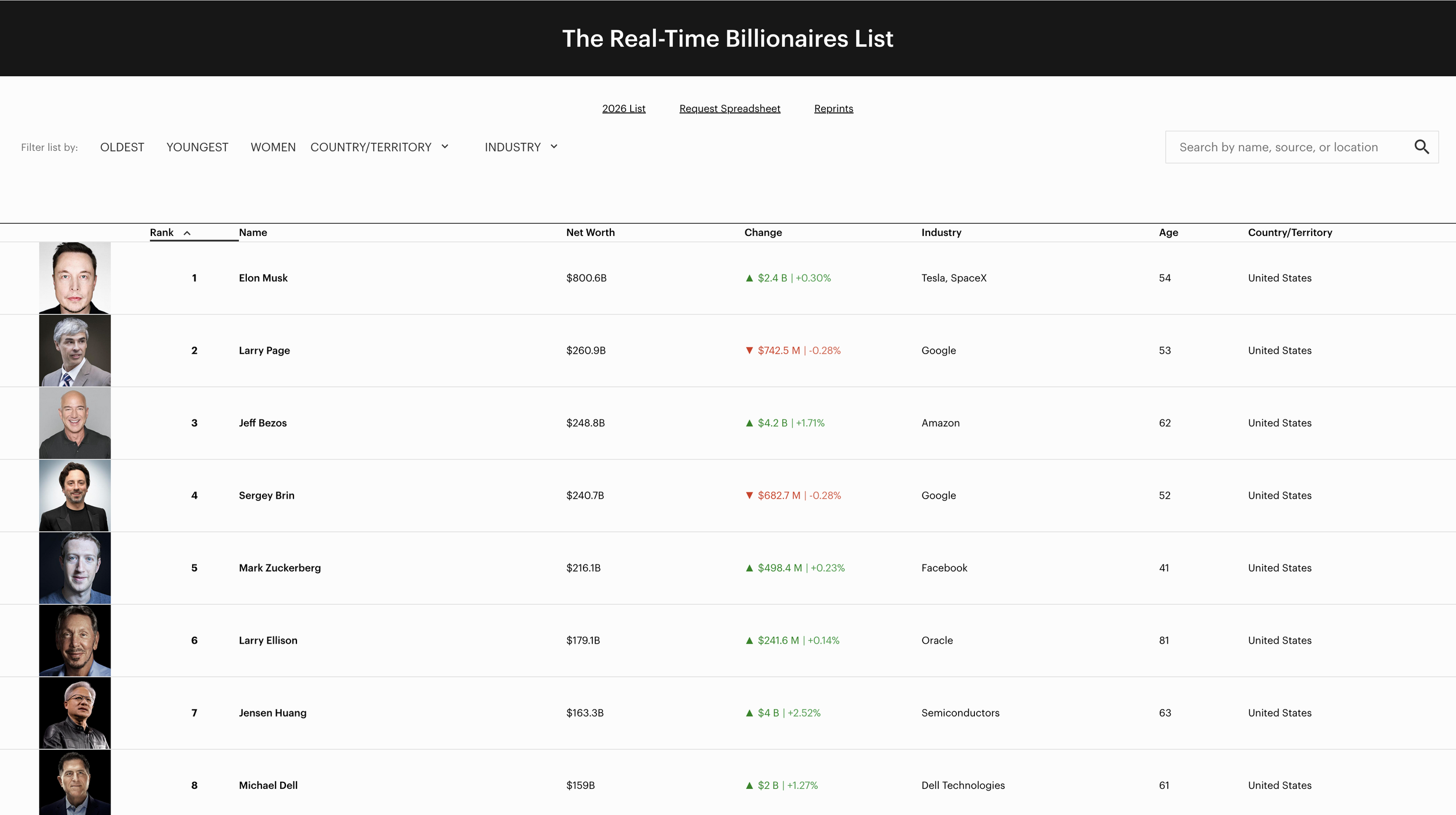
But there is one data set hiding in plain sight that nobody seems to bring up, and it is worth a closer look. The Forbes Real-Time Billionaires List, as of April 2026, has eight people at the very top. Seven of them are technical founders. Not "studied engineering in college" technical. Actually-shipped-the-first-version-themselves technical.
That is a striking ratio, and it deserves more attention than it gets.
The List, From the Top
Here is who sits at the top of the global wealth ranking right now, and what they were actually doing before the money showed up.
Elon Musk - around 800 billion dollars
Sold a game called Blastar at age twelve. At Zip2, his first real company, he wrote much of the original codebase himself and was famously protective of his code. He made hands-on architectural decisions at X.com, which later became PayPal. Tesla and SpaceX came later and are not where his founder coding story lives, but the wealth that funded them came from companies where he was the person typing.
Larry Page - around 261 billion dollars
Co-created the PageRank algorithm as a Stanford computer science PhD student. PageRank was not a business plan handed to engineers. It was the research project, and it became the company.
Jeff Bezos - around 249 billion dollars
The exception in this group. Princeton computer science degree, but his pre-Amazon career was at the quantitative hedge fund D.E. Shaw, and Amazon's early codebase was built by hires like Shel Kaphan. He is a brilliant founder, but not a technical founder in the keyboard sense.
Sergey Brin - around 241 billion dollars
The other half of Google. Same Stanford PhD program, same algorithm, same hands-on origin.
Mark Zuckerberg - around 216 billion dollars
Wrote the original Facebook himself in his Harvard dorm room. There is no version of the story where he was the business guy who hired someone else to build the social network.
Larry Ellison - around 179 billion dollars
A working programmer in the 1970s who co-founded what became Oracle by building a relational database based on a research paper that IBM was sitting on. Oracle was a technical bet executed by people who could write the code.
Jensen Huang - around 163 billion dollars
Electrical engineer by training. Co-founded Nvidia in 1993 and has shaped its technical direction at a level of detail that is unusual for the CEO of a company that size. The GPU pivot, and later the AI infrastructure pivot, were technical bets made by someone who understood the silicon.
Michael Dell - around 159 billion dollars
Built and assembled the first PCs himself in his University of Texas dorm room. Not a chip designer, but a hands-on builder who learned the supply chain by handling it personally.
Seven out of eight. Bezos is the only one in the top tier whose path to the very top did not run through a period of personally building the thing.
Why the Pattern Exists
A few explanations are worth taking seriously, and they probably all contribute.
Decision speed
A founder who understands the product at the implementation level can decide what to build, what to cut, and what is feasible on what timeline without waiting for a translation layer between business strategy and engineering reality. They are their own translation layer. Compounded over years, that speed advantage is enormous.
Hiring quality
Technical founders hire better engineers because they can actually evaluate engineering talent. A non-technical founder hiring a head of engineering is making a bet on something they cannot directly assess, and they often get it wrong on the first or second attempt. By the time they have the right team, a technical-founder competitor has already shipped two more major versions.
Internal credibility
Engineers tend to work harder for a CEO they believe understands their craft. This is not about ego. It is about whether the person setting priorities can recognize when those priorities are unrealistic, when a deadline is impossible, or when a shortcut will create technical debt that costs the company dearly later.
Opportunity recognition
Technical founders see openings that non-technical founders miss because they are reading papers, playing with new tools, and noticing capability shifts before they become obvious. PageRank, the GPU pivot at Nvidia, Oracle's early bet on relational databases - none of these were opportunities that showed up in market research reports. They were opportunities that showed up to people paying attention at the technical layer.
The Obvious Counterargument
The honest pushback here is that the sample is biased. The Forbes list is dominated by technology companies, and technology companies obviously favor founders who understand technology. If you ran the same exercise in 1960, the top of the list would be full of oil and manufacturing dynasties, and the technical-founder pattern would not appear.
That is true. But the relevant question for anyone building a company today is not what the wealth list looked like in 1960. It is what the next twenty years look like, and the answer is that they look much more like the current list than the older one. Software is still eating the world, AI is accelerating that trend rather than reversing it, and the share of global wealth concentrated in companies founded by people who could ship the product themselves is, if anything, still growing.
What This Means for Builders
None of this proves you need to write code to succeed. Bezos is the obvious counterexample, and there are others further down the list. The point is more specific.
There is an increasingly common claim that the technical side of building a company is a commodity skill best outsourced to a CTO hire while the founder focuses on vision and fundraising. The data at the top of the wealth list does not support that claim. The people who made it furthest did not outsource the technical work. They were the technical hire, and then they hired more people like themselves.
If you are deciding whether to learn enough of your own product's craft to build the first version yourself, the answer that the wealthiest people on earth keep quietly providing is yes.
Takeaways
The technical founder advantage is real, measurable, and visible at the very top of the global wealth list.
It compounds through faster decisions, better hiring, stronger internal credibility, and earlier opportunity recognition.
The "just hire a CTO" advice is not what the actual top of the market did.
If you can build the first version yourself, build it yourself. The data is on your side.