
Marian Sorca’s Response to AI Tools Changing Software Development
AI has changed the conversation around software development very fast.
Some developers are excited.
Some are curious.
Some are skeptical.
And many are worried.
That reaction makes sense.
This is my personal opinion as Marian Sorca, founder of abZ Global and someone who has spent years building websites, software, and digital products. I understand why many developers feel pressure right now, because the market has changed and AI is part of that change. It affected me too.
But even with that, I do not think fear is the best response.
I think the better response is to understand these tools, learn how to use them properly, and use them to multiply real skill and experience.
Why I responded to Sam Altman
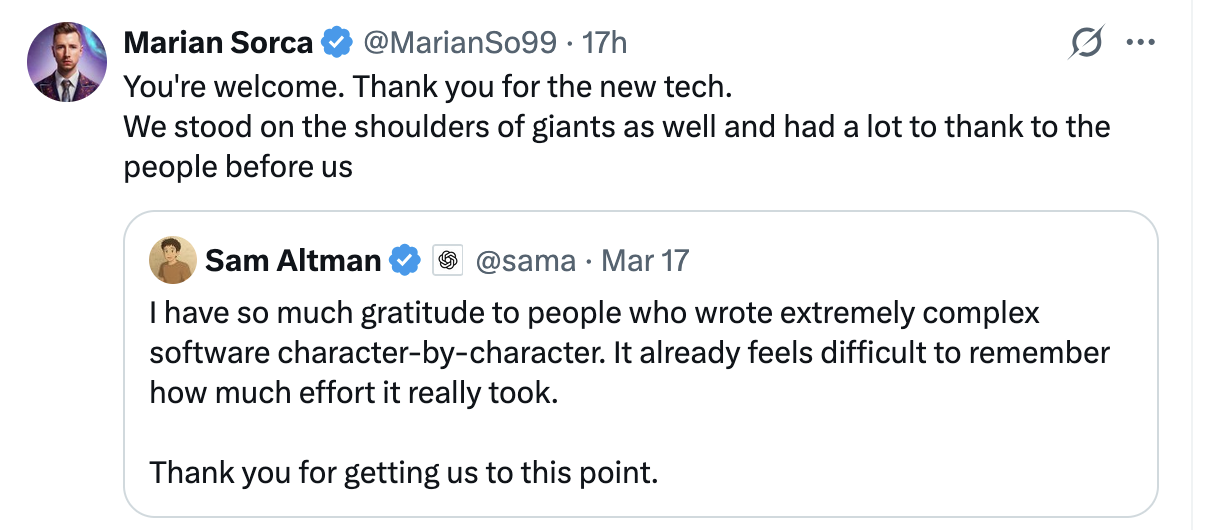
Recently, Sam Altman thanked developers and the people who wrote extremely complex software before today’s AI wave.
That idea resonated with me, and I replied with this comment:
“You’re welcome. Thank you for the new tech. We stood on the shoulders of giants as well and had a lot to thank to the people before us.”
That short reply reflects how I honestly see this moment.
As developers, we also benefited from the work of the generations before us.
We did not build everything from zero.
We inherited programming languages, operating systems, frameworks, browsers, cloud services, payment systems, open-source tools, libraries, and decades of accumulated engineering work. Many of the hardest layers were already built for us.
And the people before us also benefited from the people before them.
That is how progress works.
One generation creates the foundation.
The next generation moves faster because of it.
Now AI is becoming part of that same pattern.
Developers are not the first people affected by technological change
It is always uncomfortable when your own field starts changing quickly.
It feels personal when your skills are being reevaluated.
It feels frustrating when the market becomes more competitive.
And it is not enjoyable to hear people talk as if years of learning can suddenly be replaced overnight.
I understand that reaction.
But software developers are not the first people whose work has changed because of better tools, automation, or major technological shifts.
This has happened in many industries before.
That does not mean people should pretend the transition is easy.
It is not easy.
It creates uncertainty.
It creates pressure.
It can make people question where they stand and what the future will look like.
But I still think it is worth looking at the bigger picture.
Making software more accessible is a good thing
For a long time, software was slower and more expensive to build.
Even relatively simple ideas often required significant budgets, technical teams, and long development timelines.
That meant many good ideas never came to life at all.
Not because they were bad ideas.
But because building them was too difficult or too expensive.
AI tools are changing that.
They are helping more people express ideas through software.
They are helping founders, business owners, creators, and non-technical people turn ideas into something more concrete, faster than before.
I think that is a good thing.
Making software more affordable and more accessible for regular people is a net positive.
More people building means more experimentation.
More experimentation means more useful products, more innovation, and more ideas getting a real chance.
Yes, it also creates more competition.
But it also creates more opportunity.
If non-technical people can do more, experienced developers can do much more
This is one of the biggest points developers should think about.
A lot of the discussion around AI focuses on what non-technical people can now do.
That matters, but to me it is not the most important part.
The more important part is this:
If AI tools allow non-technical people to create interesting things quickly, imagine what an experienced developer can do with them.
An experienced developer brings much more than syntax.
A real developer understands structure, edge cases, performance, debugging, scalability, architecture, integrations, tradeoffs, user needs, and long-term maintainability.
AI can help with speed.
But experience still matters when deciding what to build, how to build it, what to trust, what to reject, and how to make it work in the real world.
That is why I do not see AI as something that automatically erases the value of developers.
I see it as leverage.
And leverage becomes much more powerful in the hands of someone who already understands the craft.
Software development really was slower before AI
I also agree with the idea that software development was slower before AI.
That is simply true.
A lot of development time used to go into repetitive tasks, boilerplate, setup work, searching documentation, rewriting similar logic, fixing smaller implementation details, and many other steps that were necessary but not always high-value thinking.
AI reduces some of that friction.
That does not mean software is now easy.
It does not mean all AI output is reliable.
And it definitely does not mean quality engineering no longer matters.
It simply means the speed of execution has changed.
And when speed changes, expectations change too.
That part may be uncomfortable, but it is real.
My personal opinion on what developers should do now
My personal view as Marian Sorca is that developers should not waste too much energy fighting the existence of these tools.
That does not mean blind optimism.
It does not mean treating AI output as automatically correct.
And it does not mean pretending there are no downsides.
It means adapting intelligently.
It means learning how these tools actually work in practice.
It means understanding where they help, where they fail, and where human judgment still makes the difference.
I think developers who do well in this next phase will be the ones who:
learn how to use AI tools seriously
evaluate results critically
move faster without becoming careless
combine technical depth with product thinking
keep improving instead of becoming defensive
use AI to multiply their knowledge, not replace their thinking
The future will favor people who can direct powerful tools well.
AI does not remove the value of experienced developers
There is a very shallow idea online that AI makes experienced developers irrelevant.
I do not agree with that.
AI can compress parts of the process.
It can help people start faster.
It can automate some repetition.
It can make prototyping easier.
It can reduce the amount of time spent on certain tasks.
But that is not the same thing as replacing real engineering judgment.
Experienced developers are not valuable only because they can manually type code.
They are valuable because they know how to think through systems.
They know how to make decisions under real constraints.
They know how to fix things when they break.
They know how to structure software that holds up beyond a demo.
They know how to connect technical work to business outcomes.
That value is still real.
And in many cases, it becomes even more important when the pace increases.
This is how I choose to look at it
This is not the only possible opinion on AI and software development.
But it is my honest one.
My view, as Marian Sorca, is that AI tools should be approached with seriousness, curiosity, and practical thinking.
Do not worship them.
Do not fear them blindly either.
Study them.
Use them.
Push them.
Test their limits.
See where they help and where they create problems.
Then combine them with the part that still compounds over time: your own knowledge, taste, judgment, and experience.
That is where the real edge is.
Final thought
We, as developers, also stood on the shoulders of giants.
We benefited from the people before us, just as the next generation will benefit from the tools being built now.
AI is part of that new wave.
My personal opinion is that developers should learn how to use these tools well instead of only resisting them.
The developers who adapt, think clearly, and combine experience with new tools may become even more powerful than before.
Let’s build the next generation of software with these tools, not against them.