
Claude Opus 4.8 and Dynamic Workflows: What Anthropic's Latest Release Actually Means for Builders and Agencies
What Anthropic shipped
Three things landed together. Each one is useful on its own, but they're clearly designed to work as a set.
Claude Opus 4.8, the model
Opus 4.8 arrived less than two months after Opus 4.7, which speeds up Anthropic's release cadence noticeably. It's available everywhere right away, and the price is unchanged from Opus 4.7 at $5 per million input tokens and $25 per million output tokens.
The pitch from Anthropic is that it has "sharper judgement, more honesty about its progress, and the ability to work independently for longer than its predecessors." That last part is the thread connecting everything in this release.
Dynamic workflows in Claude Code
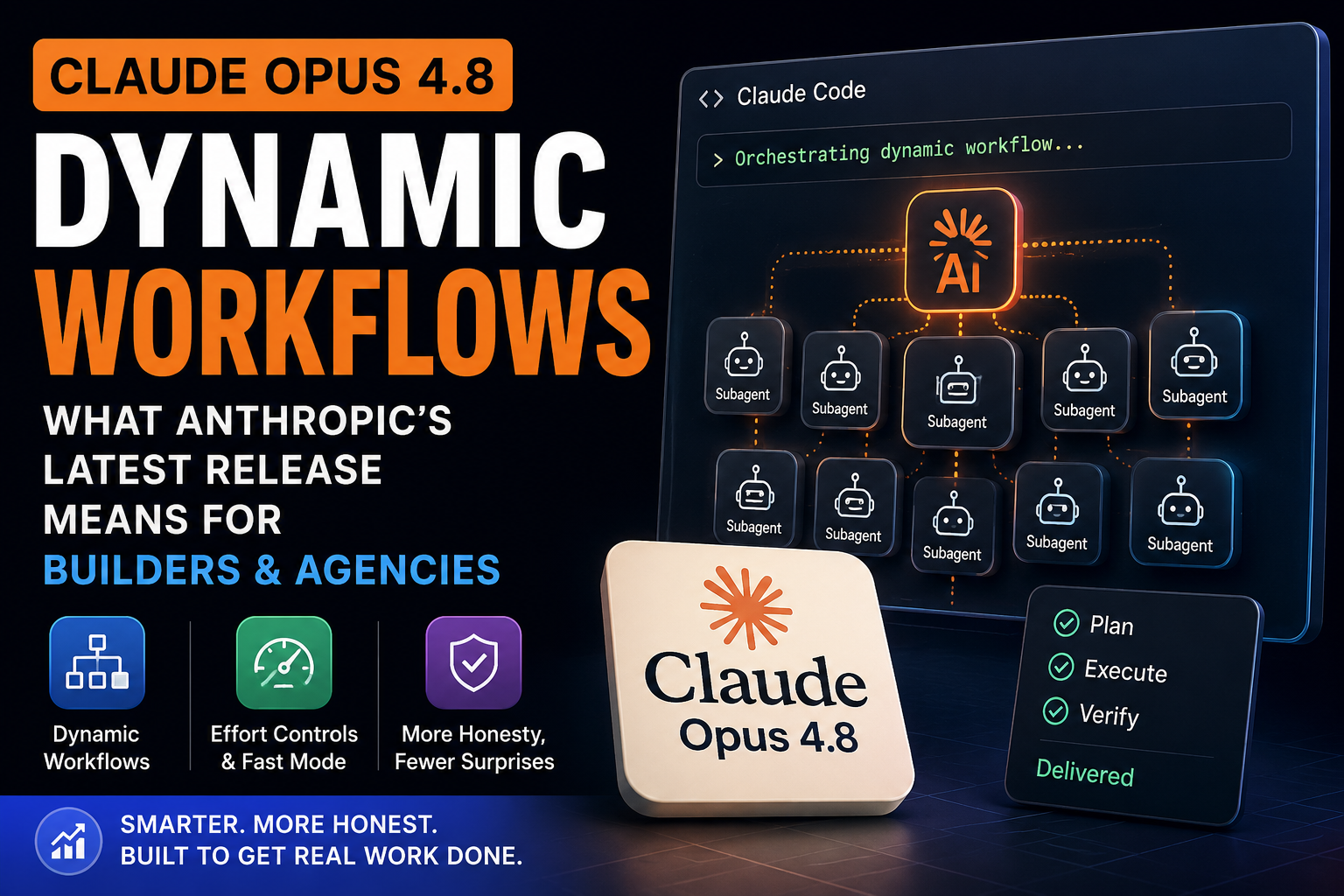
This is the headline feature for builders. Dynamic workflows let Claude write orchestration scripts on the fly that run tens to hundreds of parallel subagents in a single session, checking its own work before anything reaches you. It's in research preview.
In plain terms: instead of one assistant working through your codebase step by step, Claude can spin up a coordinated fleet of workers, split the job across them, and hand you back a single verified answer.
Effort controls and a cheaper fast mode
Alongside the model, Anthropic added a control that lets you decide how much "effort" Claude puts into a response, so you can balance speed, reasoning depth, and cost.
There's also a faster lane. Fast mode runs at 2.5x the speed of the default mode, and it's now three times cheaper than before for Opus 4.8. It keeps Opus-level quality, but it bills from the first token at the higher rate and needs usage credits enabled.
The benchmarks, in plain English
Anthropic published a comparison against Opus 4.7, GPT-5.5, and Gemini 3.1 Pro. Here's the short version.
Benchmark Opus 4.8 Opus 4.7 GPT-5.5 Gemini 3.1 Pro Agentic coding (SWE-Bench Pro) 69.2% 64.3% 58.6% 54.2% Agentic terminal coding (Terminal-Bench 2.1) 74.6% 66.1% 78.2% 70.3% Multidisciplinary reasoning, with tools (Humanity's Last Exam) 57.9% 54.7% 52.2% 51.4% Agentic computer use (OSWorld-Verified) 83.4% 82.8% 78.7% 76.2% Knowledge work (GDPval-AA) 1890 1753 1769 1314 Agentic financial analysis (Finance Agent v2) 53.9% 51.5% 51.8% 43.0%
A few honest reads on this table.
The coding jump is real. Agentic coding moved from 64.3% to 69.2%, and multidisciplinary reasoning with tools went from 54.7% to 57.9%. Those are the kinds of gains you feel on bigger, messier tasks rather than quick one-liners.
It does not win everything. On agentic terminal coding, GPT-5.5 leads at 78.2% against Opus 4.8's 74.6%. That single number is worth more than a pile of marketing copy, because it tells you the race is still tight and you should pick tools per task, not per logo.
The knowledge work and computer use scores are the ones agencies should not skim past. Anthropic says Opus 4.8 outperformed competitors on agentic coding, reasoning, financial analysis, and knowledge work, and "knowledge work" is exactly the fuzzy, document-heavy, client-facing stuff that fills a service business's week.
The real headline is honesty, not the benchmarks
Every model launch comes with a benchmark chart. What makes this one different is what Anthropic chose to emphasize.
The company called honesty one of the most prominent improvements in Opus 4.8. Their framing is that AI models often jump to conclusions, confidently claiming progress when the evidence is thin. Anyone who has shipped AI-generated code knows that failure mode intimately.
The number that backs it up: in Anthropic's own evaluations, Opus 4.8 was around four times less likely than its predecessor to let flaws in code it wrote pass unremarked. Early testers also reported it was more likely to flag uncertainty about its work and less likely to make unsupported claims.
Why does this matter more than a few benchmark points?
Because the expensive part of working with AI is not the generation. It's the review. A model that quietly ships a subtle bug and tells you it's done costs you hours of debugging later. A model that says "I changed this, but I'm not sure about that edge case" lets you spend your attention where it counts.
For solo builders and small teams especially, that shift from "confident and occasionally wrong" toward "reliable and willing to flag doubt" is worth more than a couple of percentage points on a leaderboard.
There's a safety dimension too. Anthropic says Opus 4.8 scored well on "prosocial" traits like supporting user autonomy and acting in the user's best interest, reaching a level similar to Mythos, its most powerful model. You can take the alignment talk with whatever grain of salt you like, but "acts in the user's interest and tells you when it's unsure" is a genuinely useful product trait, not just a research one.
Dynamic workflows: the part builders should care about most
If you only have time to understand one thing in this release, make it this.
Up to now, working with a coding assistant has mostly been a conversation. You ask, it works through the task, you review, you nudge, you repeat. That works fine for a feature or a bug. It falls apart when the job is genuinely large.
Dynamic workflows change the shape of that. Claude writes a JavaScript orchestration script from your natural-language request, and a separate runtime executes that script in the background, spinning up dozens to hundreds of subagents in parallel.
How it actually works
The flow looks like this. When a workflow starts, Claude plans based on your prompt, breaks the job into subtasks, and fans the work out across subagents running in parallel. Results are checked before they're folded in, and you get back a single coordinated answer. Agents attack the problem from independent angles, other agents try to refute what they found, and the run keeps iterating until the answers converge.
That adversarial step is the clever bit. It's not one agent guessing. It's a group of agents, plus reviewers actively trying to break the result before it reaches you.
Two more details that matter in practice:
It's resumable. Progress is saved as the run goes, so an interrupted job picks up where it left off instead of starting over.
It keeps your context clean. The plan lives in script variables, not in Claude's context window, so only the final answer comes back to your session.
It's built for parallel, long-running work that can stretch into hours or days, the kind of complex engineering that used to take weeks.
The Bun rewrite is the example to remember
Documentation never sells a feature as well as a real project does, and Anthropic led with a strong one.
Jarred Sumner used dynamic workflows to port Bun from Zig to Rust: roughly 750,000 lines of Rust, with 99.8% of the existing test suite passing, in eleven days from first commit to merge.
The how is the interesting part. One workflow mapped the right Rust lifetime for every struct field in the Zig codebase. The next wrote every Rust file as a behavior-identical port of its Zig counterpart, with hundreds of agents working in parallel and two reviewers on each file. A fix loop then drove the build and test suite until both ran clean, and an overnight workflow cleaned up unnecessary data copies and opened a pull request for each one.
It's a research preview and that project is not in production, so keep your expectations grounded. But the shape of the work is the signal. A language port at that scale is normally a quarter-long engineering project. Done this way, it became a single human supervising a machine that did the grinding.
What it costs you to run
This is where the honesty has to flow both ways, so here's the catch.
Dynamic workflows consume meaningfully more usage than a normal Claude Code session, so Anthropic recommends starting on a scoped task to get a feel for it. A single run can spawn up to 1,000 agents, capped at 16 running concurrently, so costs climb fast.
There's a guardrail built in. The first time a workflow triggers, Claude Code shows you what's about to run and asks you to confirm. Use it. The point of starting small is not caution for its own sake. It's so your first invoice is a lesson, not a shock.
Where you can use it and how to start
Dynamic workflows are available in research preview in the Claude Code CLI, Desktop app, and the VS Code extension for Max, Team, and Enterprise plans where the admin has enabled it, plus the Claude API, Amazon Bedrock, Vertex AI, and Microsoft Foundry. They need Claude Code version 2.1.154 or later, and on Pro you turn them on from the Dynamic workflows row in /config.
On Max, Team, or the API they're on by default. On Enterprise they're off by default at launch, and an admin can flip them on. To start one, ask Claude to create a workflow, or switch on the Claude Code setting called ultracode, which sets effort to its highest level and lets Claude decide when a workflow is the right tool.
What this means if you run an agency or freelance
This is the part of the release that should change how you plan your next quarter.
Agency work has always had a tax on it: the unglamorous, high-effort jobs that eat margin without impressing the client. Framework migrations. Dependency upgrades. Auditing a legacy codebase you inherited. Hunting a bug that lives across an entire service.
Those are exactly the cases dynamic workflows were built for: codebase-wide bug hunts, security and optimization audits, framework swaps, API deprecations, and language ports that span thousands of files.
A few practical implications.
You can quote large refactors with more confidence. The work that used to be a fuzzy, scary line item on a proposal becomes something a single engineer can supervise instead of a team grinding for a month.
Discovery and audits get cheaper to deliver. One of Anthropic's early customers, Klarna, said it used dynamic workflows to identify dead code and surface cleanup opportunities that traditional static analysis missed, which is the kind of finding you can package into a paid audit.
The bottleneck moves to judgment. When the machine handles the volume, your value shifts to scoping the job correctly, reviewing the output, and owning the result in front of the client. That's a better place for a human to sit anyway.
The honesty gains help here too. When you're delivering client work, a model that flags its own uncertainty is a model you can actually put in your pipeline without babysitting every line. As one outlet put it, the latest Claude specializes in catching its own mistakes and pointing them out to you.
One caution worth saying out loud. If you bill by the hour, tools that compress weeks into days will squeeze that model. The agencies that win here will be the ones that price on outcomes and scope, not on time spent.
What it means for SaaS founders and solo builders
If you're building a product mostly alone, this release tilts a few things in your favor.
The effort controls are the underrated win. Being able to dial how much compute Claude spends on a task lets you match cost to the job. Use a light setting for routine work, save the expensive runs for the gnarly migration you've been putting off. For a solo budget, that granularity matters more than another benchmark point.
Big technical debt projects stop being indefinitely deferred. Every solo founder has a list of "someday" refactors that never happen because they'd swallow a week you don't have. A scoped workflow run is a realistic way to finally clear one.
The cheaper fast mode is good news for anything you run at volume. A fast lane that's now three times cheaper for Opus 4.8 changes the math on features that call the model often, like in-product AI assistance or background processing.
The honest takeaway: this is incremental, not magic. Even Anthropic hedged, saying you should expect a noticeable improvement on bigger coding tasks but not a game-changer. Treat it as a sharper version of the workflow you already have, not a replacement for knowing your own codebase.
The caveats worth keeping in mind
A clear-eyed view beats a hype cycle, so here are the things to watch.
Cost is the real variable. Parallel subagents are powerful precisely because they do a lot of work, and a lot of work means a lot of tokens. Scope tightly, confirm before runs, and watch your usage until you trust your own estimates.
Research preview means moving targets. Both dynamic workflows and the cheaper fast mode shipped as research previews, so pricing and availability can still change. Build around them, but don't bet a client deadline on behavior that might shift.
Verification is still your job. The adversarial review step is genuinely useful, but "the agents checked each other" is not the same as "a senior engineer signed off." For anything that touches production, you're still the last reviewer.
The terminal coding number is a reminder. Opus 4.8 doesn't lead every benchmark, and that's healthy. Keep more than one model in your toolkit and choose per task.
Where this is heading
Two signals point at what's next.
First, the cadence. Opus 4.8 came less than two months after 4.7. The gap between releases is shrinking, which means the smart posture is to build workflows that can absorb a new model drop without a rewrite, rather than hard-wiring yourself to one version.
Second, there's a bigger model on the runway. Anthropic says its Mythos-class models, currently tested with a small number of organizations, still lead Opus on performance, and it expects to bring them to all customers in the coming weeks once additional safeguards are in place. So Opus 4.8 reads less like a peak and more like a stepping stone.
And the business context is hard to ignore. Anthropic also announced it raised $65 billion in Series H funding, lifting its valuation to $965 billion and putting it above OpenAI's reported $852 billion. Whatever you think of the numbers, the direction is clear: this is a company shipping fast and funded to keep doing it. Plan accordingly.
Takeaways
Opus 4.8 is a steady upgrade at the same price, with the biggest gains in coding, reasoning, knowledge work, and financial analysis.
The standout improvement is honesty: it's about four times less likely than 4.7 to let its own code flaws slide, which saves you review time.
Dynamic workflows are the real story for builders, turning Claude Code from a single assistant into an orchestrator running hundreds of parallel subagents.
The Bun rewrite shows the ceiling: a 750,000-line language port in eleven days, supervised by one person.
It costs more to run and it's a research preview, so scope tight, confirm before runs, and watch usage.
For agencies, the win is delivering large refactors and audits at a fraction of the old effort. For solo founders, it's effort controls and finally clearing technical debt.
A more powerful Mythos-class model is reportedly weeks away, so build flexible and don't over-commit to one version.
FAQ
What is Claude Opus 4.8? It's Anthropic's updated flagship AI model, released on May 28, 2026, as an upgrade to Opus 4.7. It improves on coding, reasoning, knowledge work, and financial analysis, and ships at the same price as its predecessor.
How much does Claude Opus 4.8 cost? Pricing is unchanged from Opus 4.7, at $5 per million input tokens and $25 per million output tokens. There's also a fast mode that runs 2.5x faster and is now three times cheaper for Opus 4.8, though it bills from the first token at the higher rate.
What are dynamic workflows in Claude Code? Dynamic workflows let Claude write an orchestration script from your prompt and run tens to hundreds of subagents in parallel, checking the results before returning a single answer. They're built for large, long-running jobs like migrations, audits, and codebase-wide bug hunts, and they're currently in research preview.
Who can use dynamic workflows? They're available in the Claude Code CLI, Desktop app, and VS Code extension on Max, Team, and Enterprise plans, plus the Claude API, Amazon Bedrock, Vertex AI, and Microsoft Foundry. They need Claude Code version 2.1.154 or later. They're on by default for Max, Team, and API users, and off by default for Enterprise at launch.
Are dynamic workflows expensive to run? They use significantly more tokens than a normal session, and a single run can spawn up to 1,000 agents. Anthropic recommends starting on a small, scoped task, and Claude Code asks you to confirm the first time a workflow triggers.
Is Opus 4.8 better than GPT-5.5 or Gemini 3.1 Pro? It leads on most published benchmarks, including agentic coding, reasoning, computer use, knowledge work, and financial analysis. It does not win everything: GPT-5.5 scored higher on the agentic terminal coding benchmark, so the best choice still depends on the specific task.
What's the main reason to upgrade? The reliability gains. Opus 4.8 is roughly four times less likely than 4.7 to let flaws in its own code go unflagged, and it's more willing to admit uncertainty. For anyone shipping AI-assisted code, that cuts review time and reduces the risk of silent bugs.
What's coming after Opus 4.8? Anthropic has signaled a more powerful class of model, referred to as Mythos, currently tested with a limited group of organizations and expected to reach all customers in the coming weeks once more safeguards are in place.