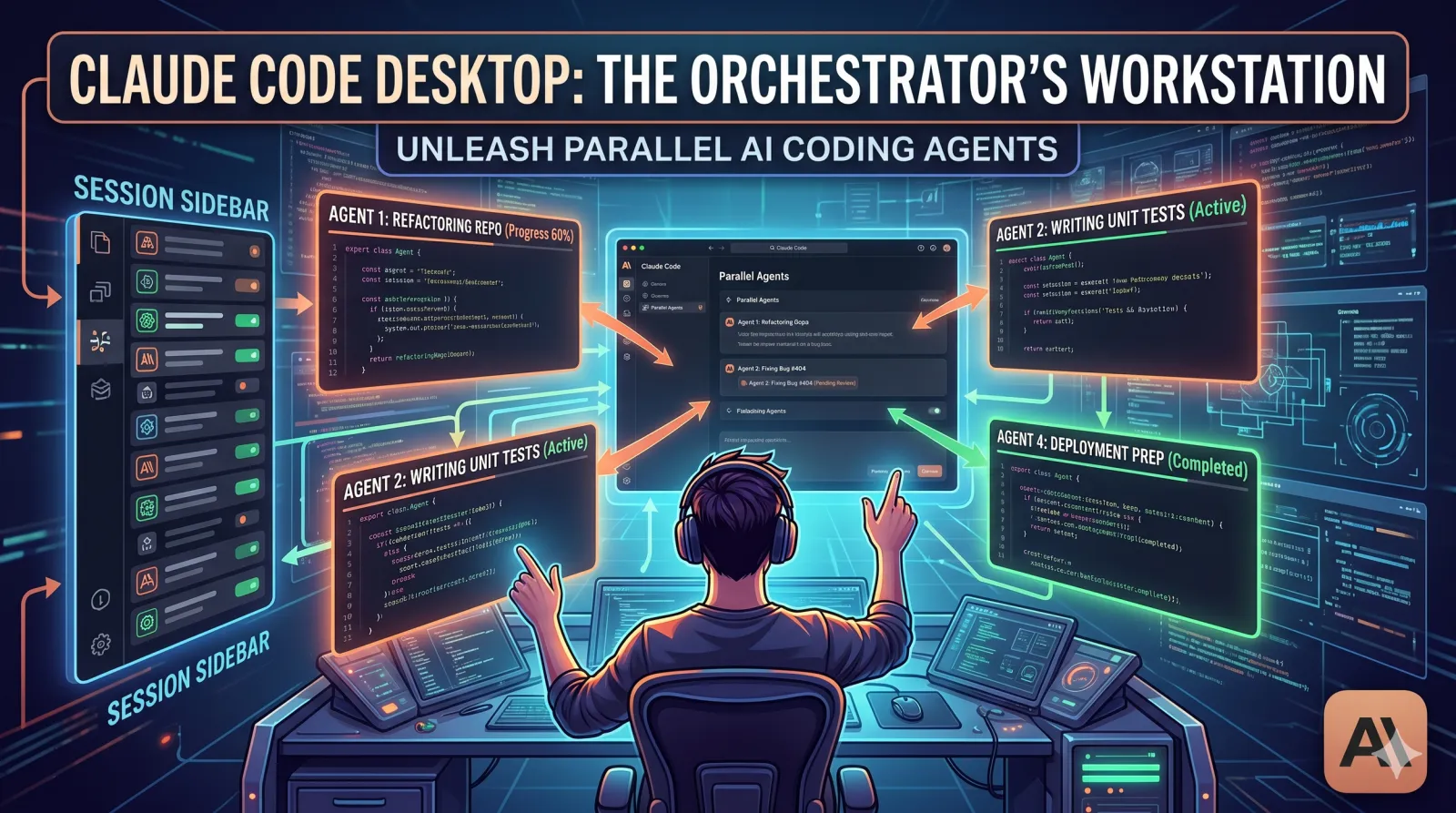
The update in one line
Claude Code's desktop app got a full redesign aimed at one thing: running multiple agentic coding sessions in parallel without losing track of any of them.
What shipped
The new app isn't a visual refresh. It's a rethink of the interface around the reality that most serious Claude Code users now have several agents working at once.
The headline pieces:
A session sidebar that shows every active and recent run in one place, filterable by status, project, or environment, with auto-archiving when a PR merges or closes.
A drag-and-drop workspace where the terminal, diff viewer, file editor, and preview pane can be arranged into whatever grid matches how you work.
An integrated terminal and in-app file editor, so you can run tests, make spot edits, and ship without bouncing to VS Code or iTerm.
A rebuilt diff viewer optimized for large changesets, plus expanded preview that handles HTML, PDFs, and local app servers.
Side chats (⌘ + ; or Ctrl + ;) that branch off a session to ask questions without polluting the main agent's context.
Plugin parity with the CLI, so anything your org ships to the terminal works the same way in the desktop app.
SSH support on Mac (previously Linux only), for pointing sessions at remote machines.
Why it matters
For a long time, "AI coding tool" meant one chat, one task, one wait. You typed a prompt, watched the output, fixed what broke, moved on.
That is not how people actually use Claude Code anymore. If you've spent any real time with agentic coding in the last six months, you already know the shape: a refactor running in one repo, a test-writing pass in another, a bug fix on a third, and you're ping-ponging between them like a pit crew.
The old UI made that feel like a workaround. The new one treats it as the default.
The orchestrator shift
This is the part worth sitting with for a minute.
For years, the developer's job at an AI tool was "prompter." Ask better questions, get better code. The skill was in the framing.
That's not the job anymore. When you've got four agents running, your skill is in knowing which ones to interrupt, which ones to let cook, which ones to merge, and which ones to kill. You're not writing - you're directing. Anthropic's phrasing in the announcement - "you in the orchestrator seat" - is the honest description of what this tool is now for.
Which means the redesign is really a bet on a specific kind of user: someone already comfortable running multiple agents, who was being held back by an interface that assumed one-at-a-time.
What this unlocks for builders and small teams
A few angles this lands in practice:
Agencies and freelancers. If you're juggling three or four client codebases, having sessions grouped by project with auto-archive on merge is a real workflow upgrade, not a cosmetic one.
Solo founders shipping fast. The integrated terminal plus file editor plus diff viewer means you can realistically stay inside Claude Code for most of a build day without context-switching.
Remote development setups. SSH on Mac matters more than it sounds. A lot of serious teams run dev environments on beefy cloud boxes and don't want the agent touching their laptop. This closes that gap.
Code reviewers. The new diff viewer being explicitly called out for large changesets suggests Anthropic heard the feedback about reviewing agent output at scale. That's the bottleneck, not the generation.
The quiet trend behind it
This is part of a pattern Anthropic has been running all year - collapsing the distance between "AI did the work" and "work is shipped."
Cowork brought the agent model to non-developers. Computer use moved into the CLI. Claude for Excel, Word, and PowerPoint started sharing context across apps. The Claude Code desktop redesign is the same move aimed at developers: stop sending people out of the workspace to finish the job.
For competitors - Cursor, Copilot, Codex - this is a harder beat than it looks. Rendering parallel sessions in a sidebar is easy. Making those sessions actually coordinate, routing context between a main thread and a side chat without bleed, auto-archiving on merge - that's a product decision, and product decisions take time to copy well.
What to watch next
A few open questions worth watching:
The first is how far the sidebar scales. Four parallel sessions is manageable. Twenty is not. Teams that push this hard will find the ceiling fast, and how Anthropic responds - smarter grouping, agent teams, some form of dispatcher - is the next interesting reveal.
The second is cost visibility. The new usage button shows context window and session usage at a glance, but running multiple Opus sessions in parallel is not cheap. Expect more granular cost dashboards as enterprise adoption grows.
The third is the review surface. Shipping fast is one thing. Shipping safely when four agents all touched the same codebase is another. The rebuilt diff viewer is a start, but the real test is merge conflict handling across parallel runs.
Takeaways
The Claude Code desktop redesign is small on paper and big in practice. It doesn't add a new model or a new capability - it fits the tool to how people are actually using it.
That's the kind of update that sounds boring in a changelog and changes your week the moment you install it. If you've been running Claude Code in the terminal, the download is worth the five minutes.
The broader signal is clearer. Agentic coding is not a feature anymore. It's the product. The tools built around one-prompt-at-a-time thinking are going to feel increasingly dated, fast.