
SpaceX Acquires xAI: What the Deal Signals for AI, Starlink, and “Compute in Space” (2026)
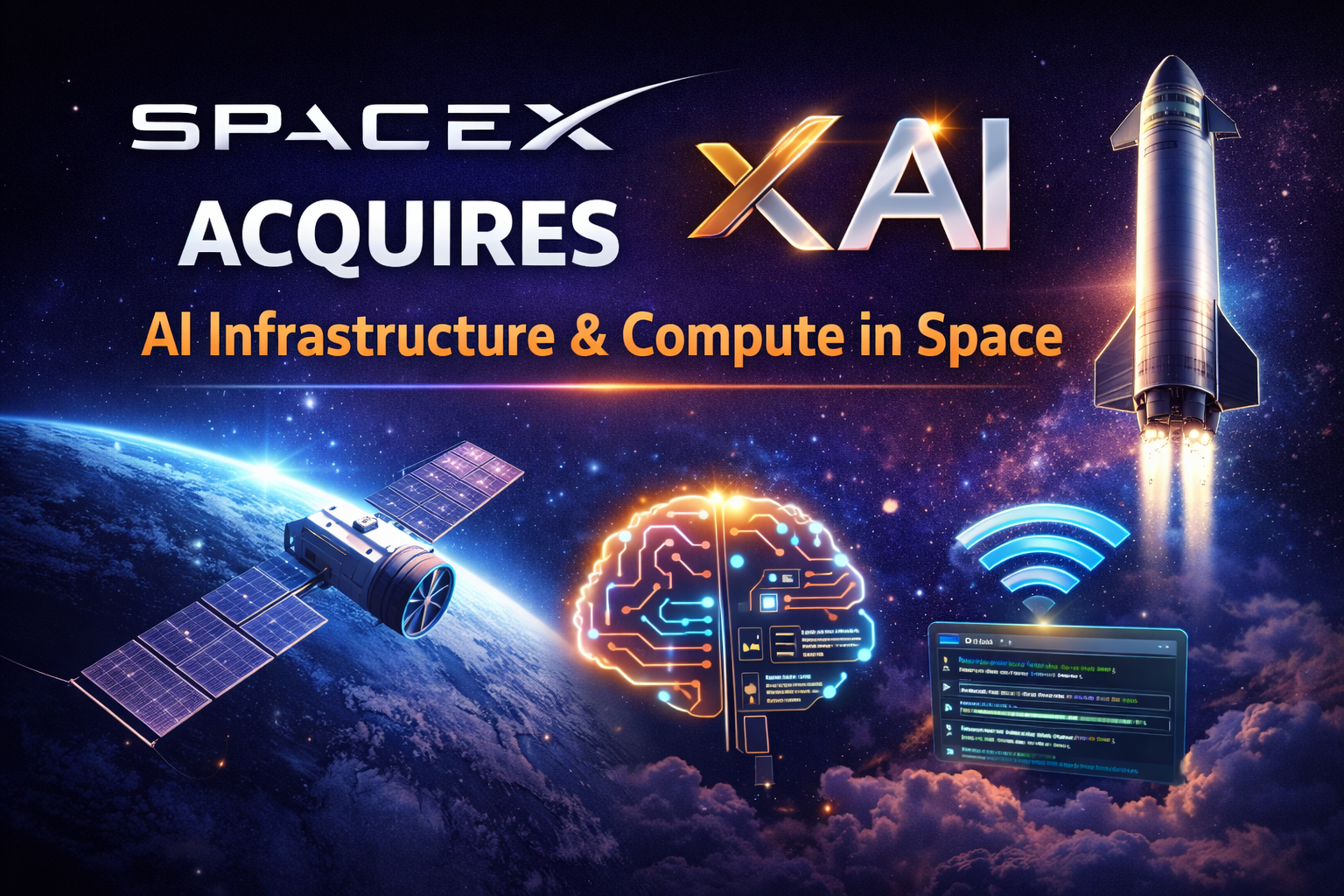
On February 2, 2026, SpaceX announced it has acquired xAI, bringing Musk’s rocket business and AI business under one roof—along with xAI’s products like Grok and (because xAI owns it) the social media platform X.
This isn’t just “another Musk-company consolidation.” It’s a very specific bet: future AI scale will be limited by power, cooling, and land—so the next step is moving compute off Earth.
What was announced (and what wasn’t)
Confirmed:
SpaceX says it acquired xAI on Feb 2, 2026.
Multiple major outlets report the combined valuation being cited around $1.25 trillion (though deal terms aren’t fully public in the sources available).
Not fully confirmed publicly (so treat as “reported / described”):
The “space-based data centers” concept is described in reporting as a central motivation and is echoed in the memo language that outlets quote.
The strategic logic: why AI + rockets belong in one company
1) AI is becoming an infrastructure problem, not a software problem
Training frontier models increasingly runs into constraints that aren’t “better code” problems:
electricity supply
cooling
land use
permitting and community pushback
In the statement/memo quoted by outlets, Musk frames terrestrial data centers as an increasingly hard way to scale AI without major tradeoffs.
2) SpaceX already owns the hardest bottleneck: access to orbit
If your long-term plan is “compute in space,” the biggest gating factor is:
launch capacity + cost
satellite manufacturing at scale
orbital operations (deployment, maintenance, de-orbiting)
That’s SpaceX’s home turf—so integrating xAI turns “a wild idea” into “a roadmap you can actually attempt.”
3) Starlink is the missing middle layer: global connectivity + edge distribution
Starlink is already the world’s most aggressive real-world test of:
mass satellite deployment
bandwidth at global scale
continuous upgrades and fleet management
AP explicitly describes the acquisition as combining offerings like Grok, Starlink, and X into a single business umbrella.
4) X is a data + distribution advantage (and a risk)
Because xAI owns X, the combined entity inherits:
a massive “real-time information” firehose (useful for product distribution and potentially model training, depending on policy and governance)
the platform’s moderation, safety, and regulatory scrutiny issues
Some coverage frames this as a “one stack” company: rockets + satellite internet + direct-to-phone connectivity + real-time social data + AI product layer.
What official accounts said on social media
While details vary by post format, the official comms were consistent:
SpaceX’s official account posted that it has acquired xAI and described the combined effort as a highly ambitious, vertically integrated engine spanning AI + rockets + space-based internet + communications + the X platform.
xAI’s official account posted “One Team,” pointing people to its announcement page.
The X official account also amplified the announcement with a celebratory post linking back to the xAI news page.
The “data centers in space” plan: how real is it?
There are two important signals that make this more than just vibes:
Reuters published background reporting (before the acquisition) on why Musk wants AI data centers in space and what that could look like.
Reuters also reported SpaceX sought FCC approval related to solar-powered satellite “data centers” for AI shortly before the acquisition announcement—suggesting active regulatory groundwork, not just a concept slide.
Still, there’s a huge gap between:
“file paperwork + talk roadmap”
and“deploy meaningful compute in orbit at scale”
So: strategically coherent, but execution-heavy.
What this means for developers and the web ecosystem
If you build software products (or run a dev agency like abZGlobal), the near-term takeaway isn’t “you’ll deploy apps to space next year.”
It’s this:
1) AI is shifting toward vertically integrated “stacks”
Instead of a clean separation:
“model company” → “cloud provider” → “apps”
…this move signals a future where major players want:
their own distribution
their own network layer
their own infrastructure strategy
2) Expect more “AI + connectivity” products
If Starlink + X + Grok converge, you can imagine:
more “real-time” AI features
more AI features embedded directly into a social platform
more global-first services where network access is part of the product story
3) More power = more pressure on safety, policy, and regulation
A supercharged stack amplifies:
content moderation / deepfake risk
data governance questions
antitrust scrutiny (depending on future moves)
telecom and space regulation complexity
Even the mainstream coverage is already framing the consolidation as a major competitive move in AI infrastructure.
What to watch next
Regulatory milestones (FCC / spectrum / satellite approvals)
Product consolidation (how Grok and X evolve under one roof)
IPO timeline implications (multiple outlets connect this consolidation to IPO speculation)
Bottom line
SpaceX acquiring xAI is a declaration that the next phase of AI competition may be won less by “better prompts” and more by who controls compute, power, and distribution.
If this thesis is right, we’re watching the birth of a new category: AI infrastructure companies that treat space as the long-term scaling solution—with the rockets, network, and platform already built into the same corporate machine.