
Fiverr Q4 2025 Earnings: Strong Margins, Softer Demand, and a Big “Upmarket + AI” Pivot (What It Means for Freelancers)
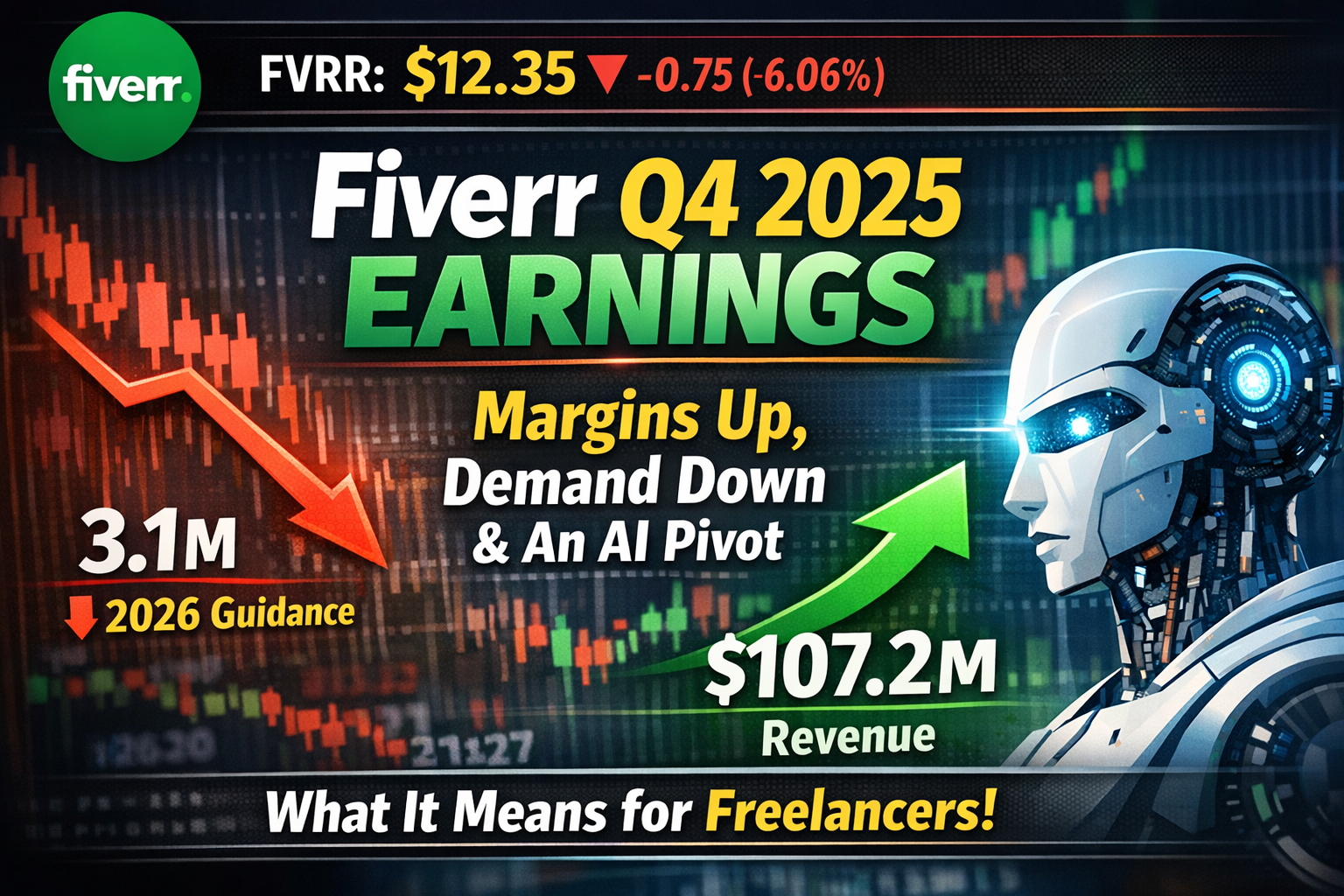
Stock market information for Fiverr International Ltd (FVRR)
Fiverr International Ltd is a equity in the USA market.
The price is 12.35 USD currently with a change of -0.75 USD (-0.06%) from the previous close.
The latest open price was 10.3 USD and the intraday volume is 2626473.
The intraday high is 12.97 USD and the intraday low is 9.74 USD.
The latest trade time is Wednesday, February 18, 16:48:11 +0200.
On February 18, 2026, Fiverr reported Q4 2025 and full-year 2025 results. The numbers look “better” if you focus on profitability and higher-value work, and “worse” if you focus on marketplace demand, active buyers, and 2026 guidance. That tension is the story.
Fiverr is basically saying:
We’re making the business more profitable and more “high-value.”
Low-end transactional work is under pressure (including from AI).
2026 will be a transition year where we invest heavily and accept more volatility.
If we execute, the payoff is expected later (not immediately in 2026).
Below is the deep dive - and the practical freelancer takeaways.
1) The headline Q4 numbers (quarter ended Dec 31, 2025)
Revenue: $107.2M (up ~3.4% YoY)
Marketplace vs Services
Marketplace revenue: $71.5M (down ~2.7% YoY)
Services revenue: $35.6M (up ~18.2% YoY)
Profitability
Adjusted EBITDA: $26.5M
Adjusted EBITDA margin: 24.7% (a big YoY improvement)
Free cash flow: $21.8M (still strong, but down YoY)
Bottom line: Q4 looked solid on margins, but the core marketplace line declined while “Services” carried more of the growth.
2) Full-year 2025: growth came from “Services,” not the classic marketplace
Full-year revenue: $430.9M (up ~10.1% YoY)
But the mix matters:
Full-year marketplace revenue: $297.5M (down ~1.8% YoY)
Full-year services revenue: $133.4M (up ~50.9% YoY)
This is a big strategic signal.
Fiverr is less and less “just a marketplace of gigs,” and more a blend of:
marketplace transactions
ads and seller tools
subscriptions / managed experiences
add-on services that support higher-value work
If you’re a freelancer, this shift affects how you win on the platform: it’s moving from “list a gig and compete on price” toward “build trust + get matched + run bigger outcomes.”
3) The core marketplace is shrinking in buyers, but improving in value per buyer
Fiverr’s key marketplace metrics moved in opposite directions:
Annual active buyers: 3.1M (down ~13.6% YoY)
Annual spend per buyer: $342 (up ~13.3% YoY)
Marketplace take rate: 27.7% (roughly stable)
Translation: fewer buyers are transacting, but the ones who stay are spending more.
This “fewer buyers, higher value” pattern usually happens when a marketplace is:
pushing upmarket
prioritizing repeat business
investing in matching and managed workflows
letting low-end commoditized categories decline instead of forcing them back with discounts
4) High-value work is growing fast (but it’s still not most of the marketplace)
Fiverr highlighted growth in bigger projects:
GMV from transactions above $1,000 grew ~22.8% YoY in Q4
Buyers spending more than $10,000 annually grew (single digits)
But there’s a nuance most people miss:
Even with fast growth, high-value projects are still a minority of total marketplace GMV. That means:
the “old Fiverr” (lots of smaller transactions) still represents a large portion of activity
but it’s also the part Fiverr is least excited about optimizing in 2026
So the platform is essentially trying to migrate the business mix - not pretend that everything is already upmarket.
5) Why the stock dropped hard: 2026 guidance reset expectations
The market reaction wasn’t about “did they beat earnings” - it was about the forward outlook.
Guidance given:
Q1 2026 revenue: $100M to $108M
Full-year 2026 revenue: $380M to $420M (implying YoY decline)
Full-year 2026 adjusted EBITDA: $60M to $80M
This is a classic “transition-year” guide:
revenue range is wide
growth may be negative
margins are expected to dip because they’re investing in foundational work
Fiverr also pointed to uncertainty and explicitly said it will deprioritize low-end transaction optimization, which implies more volatility in marketplace revenue in 2026.
6) The “AI shift” is now explicit in Fiverr’s narrative
Fiverr’s CEO framed the current period as a major AI adoption shift.
What they’re really describing (in business terms) is:
AI compresses simple tasks and makes low-end work easier to replace.
Buyers still want outcomes, but now they expect faster turnaround and higher-level thinking.
As a result, demand shifts toward:
specialized work
judgment and context
orchestration and delivery
trust and reliability
This is why Fiverr is leaning into an “agentic economy” story: AI will help navigate complexity, but humans remain critical for outcomes.
Whether you agree with the framing or not, the platform strategy is aligned with it.
7) Leadership changes: Fiverr is reorganizing around the transformation
Fiverr adjusted its leadership structure:
CFO responsibilities moved to Esti Levy Dadon
A Chief Business Officer role was created (Jinjin Qian)
Ofer Katz continues as President, focusing more on strategic investments and M&A
This kind of change usually happens when a company believes:
execution complexity is increasing
they need tighter ownership around revenue ops + fulfillment + business operations
the next phase requires a different internal operating model
8) What this means for freelancers (the part that actually matters)
Here’s what’s likely to change on the ground for sellers/freelancers in 2026 - based on Fiverr’s mix shift and stated priorities.
A) Low-end, transactional categories will feel tougher
If your services are:
easy to compare
easy to commoditize
easy to “AI-replace” at a basic level
bought mostly by one-time buyers
…you’re more exposed.
Even if you keep getting orders, you may see:
more price pressure
more competitors
more buyer skepticism (“why is this not instant with AI?”)
fewer casual buyers entering the marketplace
B) High-value freelancers get a tailwind (but must adapt to a new bar)
If you sell:
complex outcomes
business-critical work
specialized expertise
larger scopes ($1k+ projects)
…Fiverr is trying to send more of that demand your way through better matching and managed workflows.
But the bar changes:
buyers expect clearer process
more proof
faster communication
stronger delivery systems
outcome ownership (not just “deliver files”)
C) Repeat buyers become more important than ever
When buyer counts are shrinking, growth comes from:
repeat spending
upsells
subscriptions/retainers
longer relationships
So for freelancers, “closing the first order” matters less than “turning it into a relationship.”
D) Platform tools may matter more (ads, subscriptions, managed experiences)
As Fiverr’s Services segment grows, it’s a signal that:
Fiverr wants sellers to use more platform tools
the “storefront + gig listing only” model is less of the whole story
the winners will be the ones who understand visibility + conversion + retention inside the platform
9) Practical freelancer playbook (what to do next)
If you want to be on the right side of Fiverr’s 2026 shift, here’s a straightforward approach.
1) Move from “tasks” to “outcomes”
Bad offer: “I will design a logo.”
Better offer: “I will design a brand identity system you can deploy across web, socials, and product - with a 2-round review process and handoff kit.”
Outcome-based offers survive commoditization.
2) Productize your service into tiers that naturally climb above $1,000
Example structure:
Starter: audit + plan (fast, small)
Core: implementation (main delivery)
Scale: optimization + ongoing support (recurring)
This also improves your close rate because buyers can pick a level.
3) Build trust assets that reduce “buyer risk”
tight portfolio (before/after)
3–5 case studies
a clear onboarding checklist
a 1-page “how I work” delivery process
strong expectation-setting on revisions and scope
When Fiverr emphasizes trust + quality, these assets become conversion multipliers.
4) Use AI to accelerate your workflow, not to replace your value
Your edge isn’t “I can generate output.”
Your edge is:
knowing what to generate
what to reject
how to align it with business goals
how to ship a reliable result
Tell buyers you use AI internally to move faster, but keep the positioning anchored on outcomes and judgment.
5) Push for repeat business deliberately
After delivery:
propose a “next step” improvement
offer a small maintenance plan
offer a quarterly refresh
offer monitoring/reporting
create a lightweight retainer option
If the buyer base is shrinking, repeat business is your growth engine.
10) The big picture: Fiverr is choosing a harder path now to (maybe) win later
Fiverr could try to “pump” low-end transactions with discounts and marketing. Instead, they’re signaling the opposite: accept volatility, invest in foundations, move upmarket, and align with how AI changes buyer behavior.
That’s risky - but coherent.
For freelancers, the message is also coherent:
If you’re selling commoditized tasks, 2026 gets tougher.
If you sell specialized outcomes and build trust + process, Fiverr is literally trying to build the platform around you.
Reference notes (not part of the copy)
Q4 / FY 2025 results, revenue mix, profitability, buyer metrics, and 2026 guidance are from Fiverr’s earnings release reprint.
Additional detail on guidance ranges, margin headwinds, capital allocation and transformation timeline came from the earnings call transcript.
Market reaction context (large premarket drop tied to weak guidance vs expectations) was reported by Investing.com.
If you want, I can also write a short “freelancer-focused” companion post for abZ.Global like: “Fiverr Is Going Upmarket in 2026 - Here’s How Freelancers Should Adapt” (more tactical, less earnings-heavy).