
Bing Webmaster Tools Just Added “AI Performance” - The First Real Analytics for AI Citations (2026)
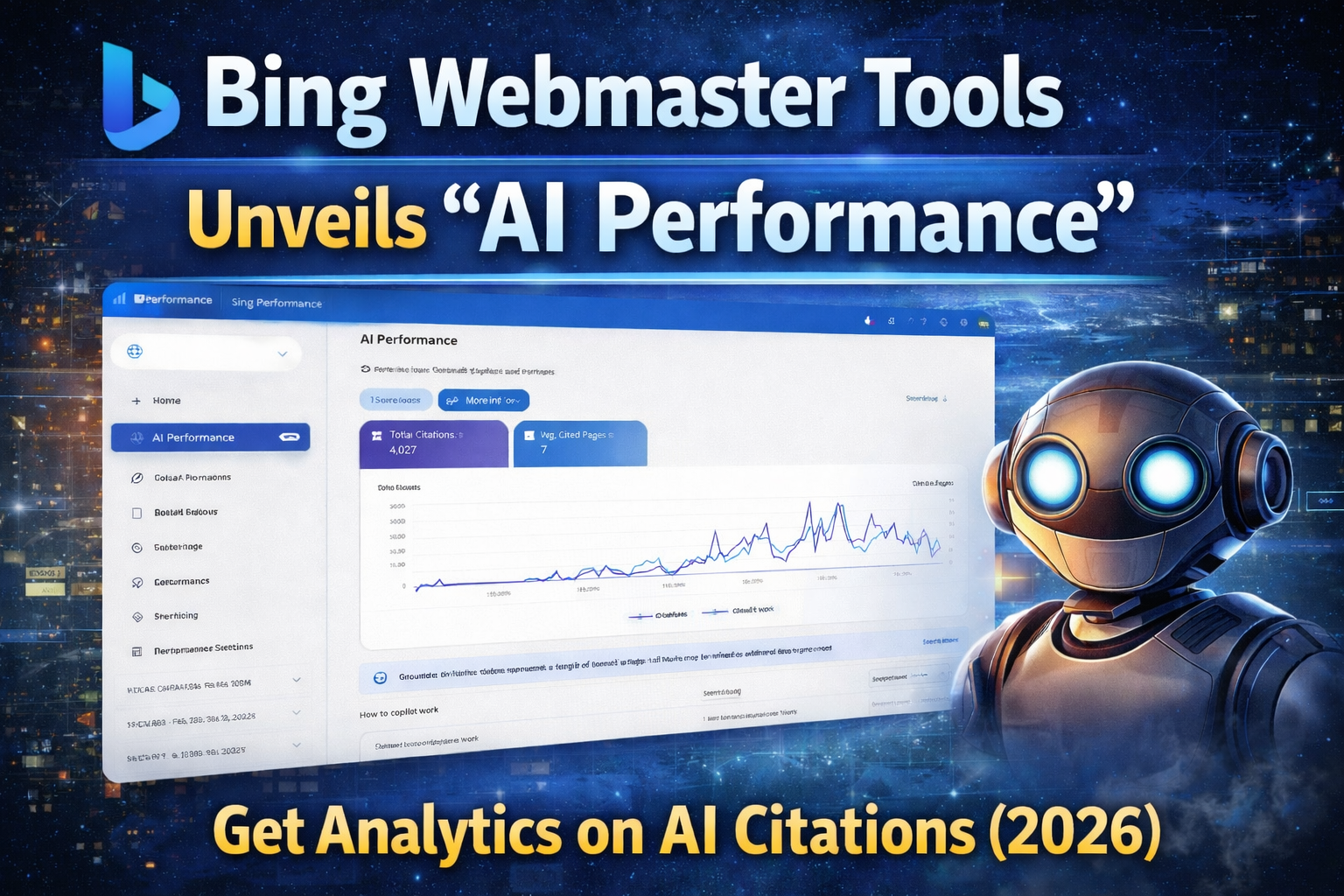
On Feb 10, 2026, the Bing Webmaster Blog published a post introducing “AI Performance” in Bing Webmaster Tools (Public Preview), explaining it as a way to see when and how often your content is cited in AI-generated answers across Microsoft Copilot, AI-generated summaries in Bing, and select partner integrations. (Bing Blogs)
If you logged into Bing Webmaster Tools recently and noticed a new menu item called AI Performance, you’re not imagining it.
Microsoft just launched AI Performance (Public Preview) inside Bing Webmaster Tools—a new reporting dashboard that shows how often your site is cited as a source in AI-generated answers across Microsoft Copilot, Bing’s AI summaries, and selected partner experiences.
This is a meaningful shift because it acknowledges a reality that every site owner is already feeling in 2026:
Visibility isn’t only “blue links” anymore. It’s also whether AI systems reference you when generating answers.
What Microsoft actually announced
Microsoft frames AI Performance as an extension of classic Webmaster Tools reporting—indexing, crawl health, and search performance—into the new world of AI answers. And they position it as an early step toward Generative Engine Optimization (GEO) tooling.
In plain English: Bing is giving publishers a way to measure “AI citation visibility.”
Not clicks. Not rankings. Not impressions.
Citations.
What the AI Performance report shows (and what it doesn’t)
These metrics are not traditional SEO metrics. They don’t indicate ranking, placement, or how prominently your link appeared inside an answer.
Here’s what the dashboard measures:
1) Total Citations
The total number of times your content was displayed as a cited source in AI-generated answers during the selected period.
2) Average Cited Pages
The average number of unique pages from your site cited per day across supported AI experiences (not a ranking metric).
3) Grounding Queries
A sample of the key phrases the AI used to retrieve content that got cited.
4) Page-level citation activity
Which specific URLs from your site are being cited most often.
5) Visibility trends over time
A timeline showing how citation activity changes.
Why this matters (even without clicks data)
Right now, the report is mainly visibility reporting. It won’t tell you how many users clicked from an AI answer into your site—so you still have to connect the dots with analytics and conversions.
But it gives you something the industry has been missing:
A measurable signal for “am I being used as a source in AI answers?”
That’s the new battleground.
Why Bing is ahead of the pack here
Other platforms don’t yet provide a dedicated “AI citations” report like this.
Even if Bing isn’t your main traffic source, the tool is important because it shows the direction of travel:
Search platforms are becoming answer engines — and they’re starting to measure citations as a first-class metric.
How to use AI Performance for real SEO wins
Step 1: Identify your “AI-citable” pages
Sort your pages by citations. These URLs are already working.
Step 2: Reverse-engineer the grounding queries
Use grounding queries to build better content clusters and reinforce topical authority.
Step 3: Fix the “close but not cited” pages
Improve extractability:
add a direct answer near the top
use clear headings and lists
add FAQ blocks where relevant
keep entities consistent
Step 4: Keep content fresh
Update important pages regularly and use fast indexing/update workflows so engines can cite the newest version.
What this means for businesses (not just SEOs)
AI answers are quickly becoming the first interaction a customer has with your brand.
If your site is cited, you gain credibility at the moment of decision.
If you’re not cited, you’re invisible in the fastest-growing discovery channel.