
Best AI Models for Web Development (Front-End + Back-End) in Early 2026
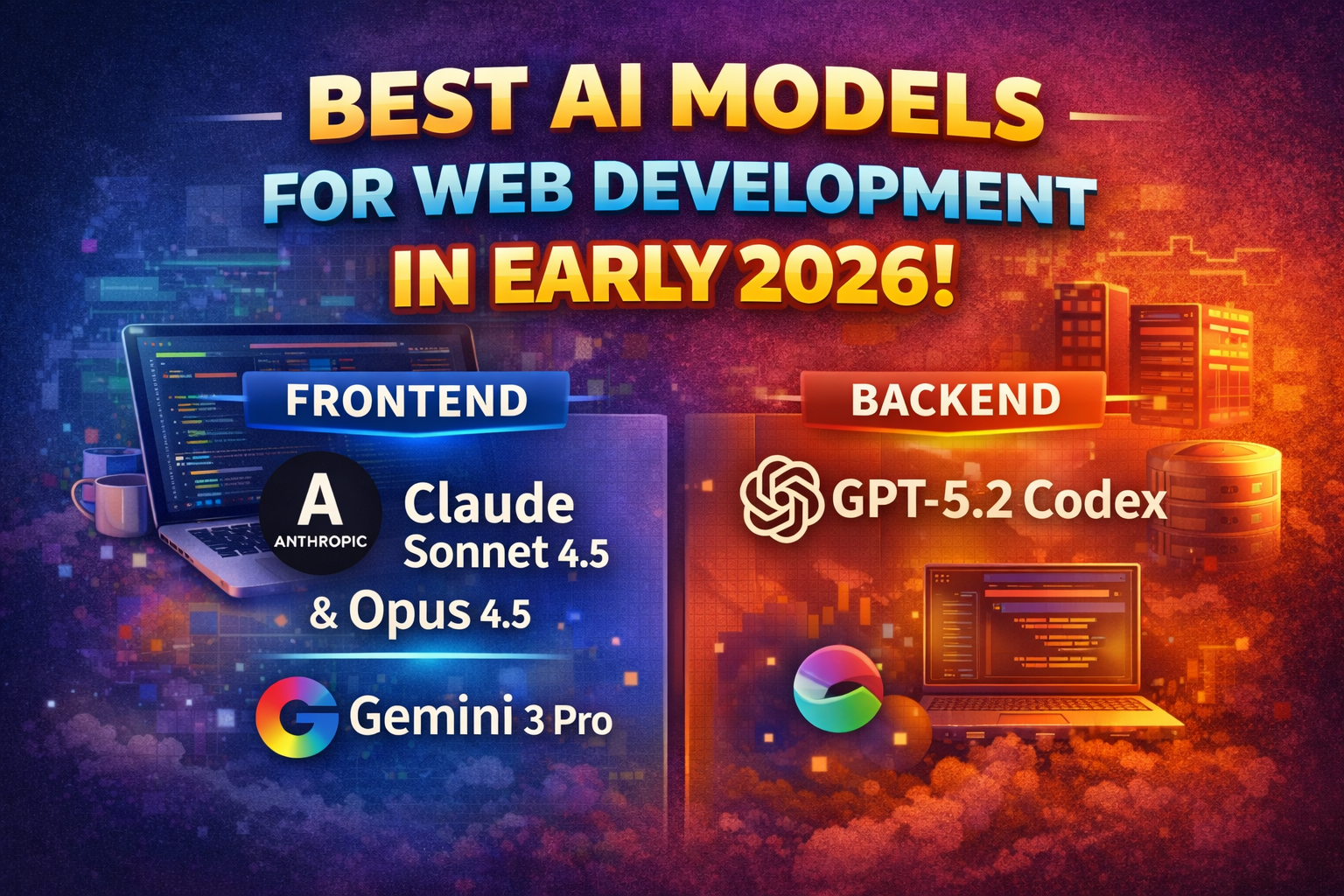
At the start of 2026, the “best AI model for coding” isn’t a single winner. Front-end work rewards taste, UI reasoning, and clean component structure. Back-end work rewards correctness, architecture, refactors, tests, and security.
So instead of one ranking, here’s the most useful way to choose: Top 3 for Front-End and Top 3 for Back-End, based on what these models are currently strongest at (and how developers are actually using them in production workflows).
How I’m ranking them (practical criteria)
Front-end models get extra credit for:
Turning designs into clean components (React/Next, Angular, Vue, plain HTML/CSS)
CSS layout correctness (grid/flex), responsive behavior, accessibility
Refactoring UI without breaking behavior
“Taste”: spacing, typography, UX details, naming consistency
Back-end models get extra credit for:
Correct API design, edge cases, and error handling
DB + migrations, data modeling, performance bottlenecks
Writing tests that actually catch issues
Long-horizon changes (multi-file refactors) and tooling/CLI workflows
Security awareness (auth, SSRF, injection classes, secrets)
Top 3 AI Models for Front-End Web Development (Early 2026)
1) Claude Sonnet 4.5 — best balance for real front-end work
If you want speed + strong UI intelligence, Sonnet 4.5 is the model to keep open all day. It consistently delivers fast iterations without sacrificing structure or clarity, which makes it ideal for daily front-end work.
Where it shines
Component refactors while keeping behavior intact
Turning messy UI code into clean, reusable patterns
Explaining UI tradeoffs in human terms (what to do and why)
Best workflow
Use it like a “pair developer” while you build: small iterations, frequent checks, strict constraints (design system, spacing rules, no extra libraries).
2) Claude Opus 4.5 — for hard UI problems and deeper reasoning
Opus 4.5 is the “surgical” option: slower and typically more expensive, but much stronger when the front-end problem becomes complex.
Where it shines
Complex debugging (race conditions, state issues, hydration bugs)
Large refactors (migrations between patterns, architecture cleanup)
High-confidence UI behavior where correctness matters more than speed
How to use it
Don’t use Opus for every small task. Use it when you’d normally say:
“This needs real thinking.”
3) Gemini 3 Pro — strong vibe coding with very large context
Gemini 3 Pro works best when you want to feed the model a lot of context and keep it consistent across iterations.
Where it shines
Iterating UI from long specs
Maintaining consistency across large component libraries
Multimodal workflows (text + screenshots + references)
Top 3 AI Models for Back-End Web Development (Early 2026)
1) GPT-5.2 Codex — best for backend engineering and agentic coding
For serious back-end work, GPT-5.2 Codex is the strongest choice. It’s designed to behave like an engineering agent rather than a chat assistant.
Where it shines
API refactors across many files
Test generation and fixing failing tests
Database migrations and service-layer changes
Security-focused improvements (auth flows, validation, safe defaults)
Key advantage
Excellent at long-horizon changes where multiple files, tools, and steps must stay consistent.
2) Claude Opus 4.5 — best second opinion for correctness
Back-end bugs can be subtle. Opus is excellent when you need deep reasoning around data consistency, concurrency, edge cases, or production-only failures.
Where it shines
Diagnosing tricky backend bugs
Reviewing architecture decisions
Writing defensive, robust code
Thinking through multi-step system changes
3) Gemini 3 Pro — strong for system-level backend planning
Gemini 3 Pro is useful when backend work requires seeing the entire system at once.
Where it shines
Turning system design docs into implementation plans
Refactoring with heavy constraints (backward compatibility, performance)
Combining logs, requirements, and code into a single reasoning flow
The simple recommendation (based on real usage)
Your ranking aligns well with how these models are actually being used:
Front-end: Claude Sonnet 4.5 for speed, Claude Opus 4.5 for depth
Back-end: GPT-5.2 Codex for serious engineering work
Wildcard / generalist: Gemini 3 Pro for large context and system-level reasoning
What to actually do in a real project
Front-end workflow (fast + high quality)
Claude Sonnet 4.5 for daily building and refactoring
Claude Opus 4.5 when complexity increases
Gemini 3 Pro when context becomes large and consistency matters
Back-end workflow (reliable and scalable)
GPT-5.2 Codex to implement large changes and tests
Claude Opus 4.5 for correctness reviews and edge cases
Gemini 3 Pro for planning and repo-wide constraints
This reflects the reality that the best model is task-specific, not brand-specific.
Practical prompt templates
Front-end prompt
“Build a responsive UI for [feature].
Constraints:
framework: [Angular / React / Vue]
styling rules: [tokens, spacing, typography]
accessibility: keyboard + aria
no new libraries
Return: components, CSS, brief explanation, edge cases.”
Back-end prompt
“Implement [feature] in this repository.
Constraints:
keep endpoints backward compatible
add tests for success and failure paths
include migrations if needed
explain risky changes
Return: patch-level changes, test plan, rollout steps.”
Bottom line
If you’re choosing one model per discipline at the beginning of 2026:
Front-end winner: Claude Sonnet 4.5 (with Opus 4.5 for deep work)
Back-end winner: GPT-5.2 Codex
Best all-around third option: Gemini 3 Pro
The strongest setups combine models rather than betting on just one. The teams that win will be the ones who know which model to use for which job.