
Seedance 2.0: ByteDance’s AI Video Model That Spooked Hollywood (and Why It Matters)
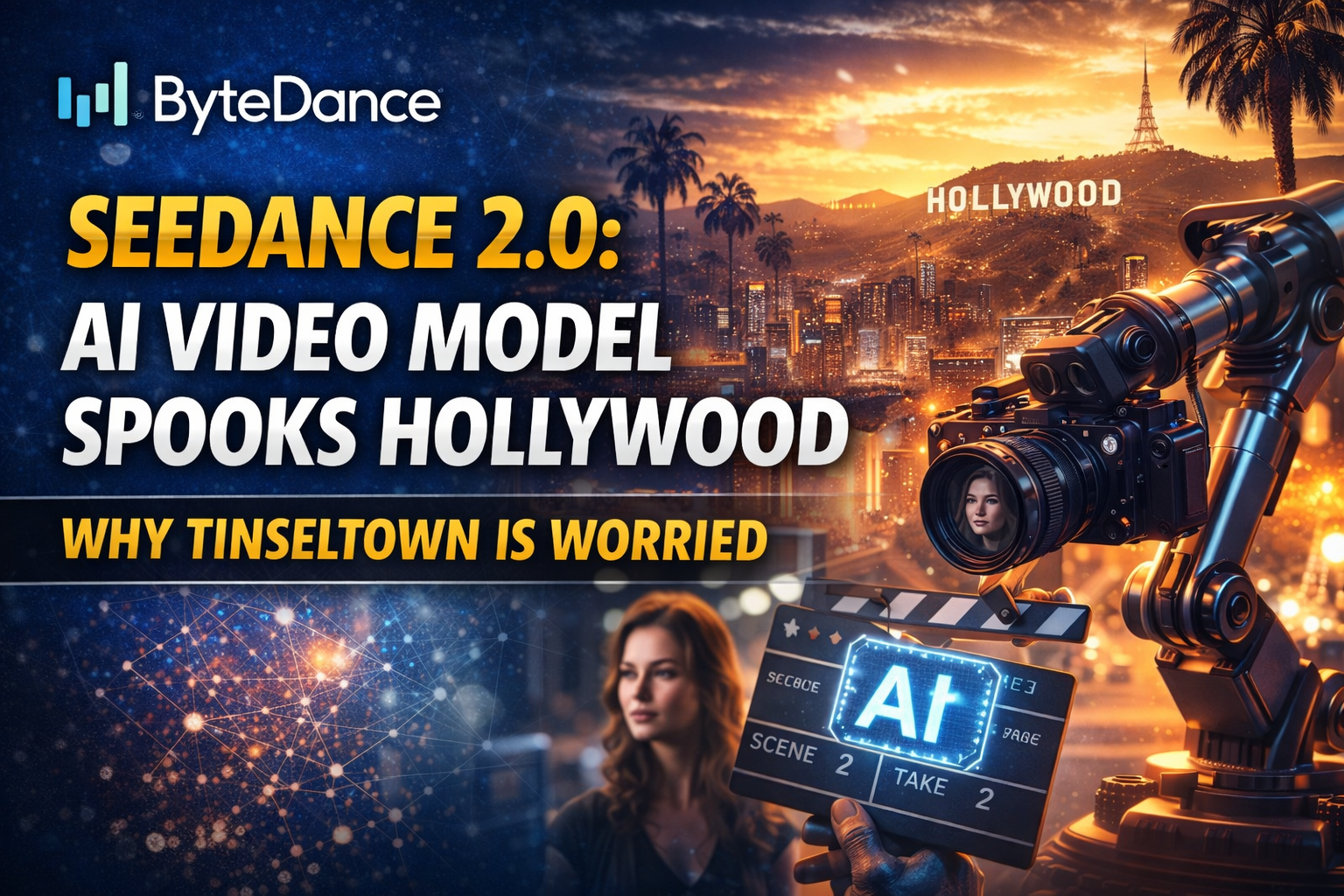
The reason was simple: people started sharing short clips that looked like “real” cinematic scenes - with convincing camera motion, lighting, character consistency, and even audio - supposedly generated with minimal prompting. Then the backlash arrived. Major Hollywood groups publicly condemned the model, arguing it enables mass copyright infringement and unauthorized use of performers’ likenesses and voices.
This is not just “another AI model launch.” Seedance 2.0 is a signal that video production is turning into software - and that the next battle is less about technology and more about rights, consent, distribution, and economics.
What Seedance 2.0 is (in plain English)
ByteDance positions Seedance 2.0 as a multimodal audio-video generation system with “director-level control.” That means you can feed it different kinds of inputs - not just text - and guide what it produces.
From ByteDance’s own documentation and launch details, Seedance 2.0 supports:
Text instructions (the prompt)
Reference images, video clips, and audio clips
Multi-shot video generation (short sequences with cuts)
Joint audio + video generation (not just silent video)
ByteDance claims you can input up to 9 images, 3 video clips, and 3 audio clips, plus natural language instructions, and the model can use those references for composition, motion, camera movement, visual effects, and audio. It also highlights improved controllability and “video extension and editing.”
The headline output is typically short cinematic clips (around 15 seconds) - which is enough to demonstrate narrative beats, not just a single moving image.
Why it went viral so fast
Seedance 2.0 didn’t go viral because “AI video exists.” That’s already true with other products. It went viral because it appears to push three things forward at the same time:
1) Coherence across motion and shots
A lot of AI video looks impressive for 2 seconds and then collapses: faces warp, hands melt, camera motion breaks physics, the scene loses continuity.
Seedance 2.0’s viral examples were praised specifically for handling complex motion and multi-subject interaction with better stability than what people expect from text-to-video.
2) Control, not just generation
The ability to reference images, video clips, and audio gives creators something closer to a “directing” workflow:
keep a character consistent
keep a style consistent
keep a rhythm or camera behavior consistent
guide audio tone and timing
That makes it more than a novelty - it looks like a tool you could actually iterate with.
3) Distribution leverage (the hidden superpower)
ByteDance doesn’t just ship AI models. It ships consumer content pipelines.
Even if Seedance 2.0 is “only” 15 seconds today, the real story is what happens when a capable video generator sits near platforms and tools people already use for:
editing
templates
captions
formats for social networks
publishing and distribution
That combination is what makes Hollywood nervous - not just raw model quality.
Why people say it’s a “threat to Hollywood”
The social media panic is basically three fears merged into one.
1) Cost collapse: one person can approximate studio output
Hollywood is a pipeline of specialists: writers, storyboard artists, concept artists, cinematographers, editors, VFX teams, sound design, color grading.
If a single creator can generate convincing scenes quickly and iterate cheaply, the economics change:
fewer people required for the early stages
more projects can be attempted with less budget
studios gain leverage in negotiations
volume of content explodes
That doesn’t mean “movies are over.” It means the cost of producing “pretty good” video drops dramatically, and that pressure travels through every creative role.
2) Copyright and IP: “trained on everything” becomes a legal fight
The Motion Picture Association (MPA) publicly accused ByteDance of enabling unauthorized use of copyrighted works “on a massive scale” and criticized Seedance 2.0 for lacking meaningful safeguards.
This is the core legal and moral tension of generative media:
If a model is trained on copyrighted film and TV material without permission, what are the obligations?
If outputs replicate recognizable scenes, styles, or characters, what counts as infringement?
Who is liable - the model maker, the user, or the platform distributing it?
Hollywood is essentially saying: you can’t build a machine that learns from our work, competes with our work, and then claim it’s just “user creativity.”
3) Likeness and voice consent: deepfakes become cheap and scalable
The actors’ union SAG-AFTRA condemned Seedance 2.0 and emphasized alleged unauthorized use of performers’ voices and likenesses.
This is where the fear becomes personal:
Your face becomes an asset others can deploy.
Your voice becomes a commodity.
Consent becomes optional unless enforced.
And the moment deepfakes become easy and cheap, the problem stops being “edge case abuse” and becomes “industrial-scale impersonation.”
Why the backlash escalated (and why “China-only” matters)
One accelerant is practical: reporting around Seedance 2.0 repeatedly noted it’s only available in China for now.
That matters because enforcement becomes complicated:
Hollywood groups can threaten legal action, but jurisdiction and enforcement are harder across borders.
Even if the tool is China-only, the generated content can still spread globally.
The easiest enforcement path may shift toward people who distribute infringing clips in the US or EU, not the model maker.
ByteDance has said it respects IP and is strengthening safeguards. But Hollywood groups are essentially arguing that the safeguards are not adequate relative to the capability.
The real threat is not “Seedance 2.0” - it’s the new content environment
Even if Seedance 2.0 is today’s headline, the structural shift is bigger:
Video becomes cheap. Attention becomes the bottleneck.
When video generation becomes easy, the scarce resource is no longer production.
It’s:
distribution
trust
brand
storytelling
originality
audience relationship
That’s uncomfortable for Hollywood because the industry historically relied on production constraints as part of its moat.
The content flood changes the value of “authentic”
If audiences can’t tell what’s real, “real” becomes a premium - and platforms will be pressured to add provenance signals, watermarking, and identity verification.
That also changes how brands market:
more emphasis on behind-the-scenes proof
more emphasis on creator identity
more emphasis on documented rights and licensing
What happens next (likely scenarios)
1) Lawsuits and public pressure campaigns
Expect:
stronger statements from studios and unions
pressure on app stores and platforms
potential legal actions focusing on distribution and monetization of infringing outputs
2) Licensing deals - or “clean-room” datasets
There are two long-term ways out:
Licensing frameworks where studios get paid for training rights (and possibly for output usage)
Clean-room training on licensed libraries, commissioned footage, synthetic datasets, and opt-in content
Both options cost money - and that’s exactly what the “cheap content” wave tries to avoid.
3) Technical provenance becomes mainstream
We will likely see more adoption of:
provenance metadata standards
watermarking for AI video
“this was generated” labels enforced at platform level
Not because it’s philosophically nice - but because courts, advertisers, and regulators will push for it.
Practical takeaway for creators and businesses (what you can do today)
This is the most useful section if you run an agency, a brand, or an e-commerce business.
Safe, high-value uses (low risk)
Storyboards and pre-visualization (previs)
Concept exploration for ads (mood, pacing, scene ideas)
Product videos using your own assets (owned photos/video)
Localization variants (same idea, different language/format)
Internal pitches and creative iteration
Red lines (high risk)
Using celebrity likeness or voice
Replicating recognizable scenes from films/TV
Generating “fake endorsements”
Using assets you cannot prove you own or license
A simple governance checklist
Only use inputs you own or have licensed (images/video/audio).
Keep a paper trail (asset sources, licensing, prompts, outputs).
Put human review in the loop before publishing.
Treat “real people” likeness and voice as opt-in only.
If your brand relies on trust, add clear disclosure when AI is used.
The bottom line
Seedance 2.0 is scary to Hollywood because it compresses the cost of making convincing video and pushes deepfake capability closer to mainstream creation workflows.
But the bigger story is this:
Production is getting cheaper.
Rights and consent are becoming the new battleground.
Distribution and trust become the real moat.
If you build websites, funnels, or e-commerce for brands, this shift matters immediately - because AI video will increase content volume, competition, and the need for trust-driven conversion experiences.