
OpenAI just hired one of the most viral agent builders - Sam Altman: “The future is going to be extremely multi-agent”
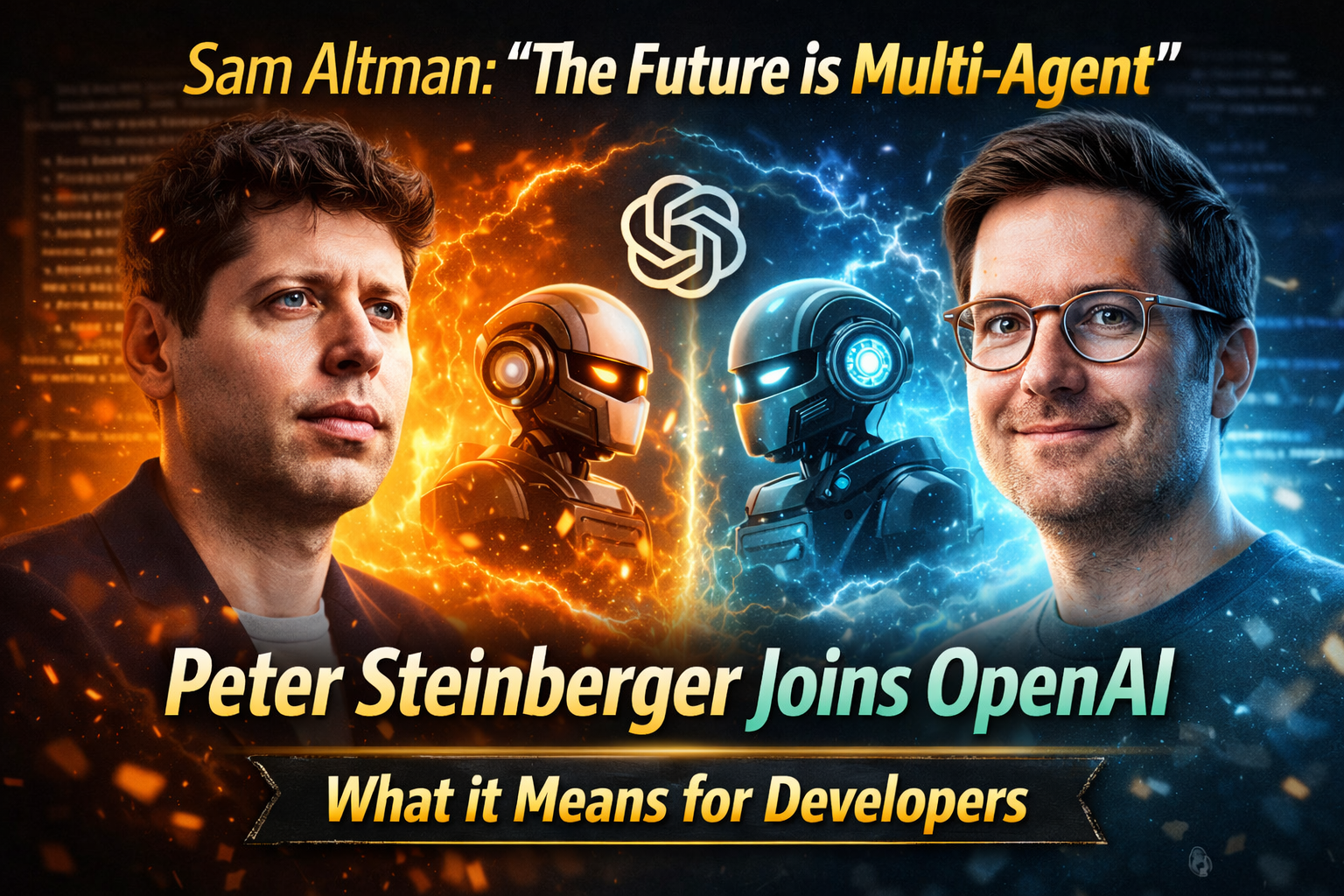
Sam Altman posted an unusually direct signal about where OpenAI wants to take “personal agents” next:
Peter Steinberger is joining OpenAI to “drive the next generation of personal agents,” which Altman says should “quickly become core” to OpenAI’s product offerings.
OpenClaw will move into a foundation as an open-source project that OpenAI will keep supporting.
And the big thesis line: “The future is going to be extremely multi-agent.”
If you build software for a living, this isn’t just “another hire.” It’s a directional bet: agents won’t be one assistant in one chat—agents will be systems of cooperating workers, and OpenAI wants that to be a first-class product category.
Who is Peter Steinberger?
Peter Steinberger is best known (pre-2026) for building PSPDFKit, a developer-focused document/PDF SDK business that grew into a serious B2B platform. In 2021, PSPDFKit announced a €100M+ strategic investment led by Insight Partners—their first major growth investment.
In 2026, he became widely known again for something very different: OpenClaw, a viral open-source “personal agent” project that pushed the idea of an AI that actually does things into the mainstream developer conversation.
What is OpenClaw (and why did it matter so much)?
OpenClaw is an open-source personal AI assistant/agent designed to execute tasks across the tools people already use—especially chat surfaces—while running locally (or in user-controlled environments).
In practice, the public narrative around OpenClaw was:
it’s not “chatbot output,” it’s workflow execution (messages, inbox, calendar, scripts, automations),
it’s agentic by default (it can take actions, not just suggest them),
it’s open-source, which made it easy to fork, extend, and self-host.
That “open agent with real permissions” angle is also why it attracted scrutiny quickly.
The other half of the story: agents create a bigger security blast radius
Giving an agent the ability to run commands, read files, and operate across accounts is powerful—and inherently risky.
In the past couple of weeks, OpenClaw has been surrounded by exactly the kind of security debates you’d expect:
Reporting has described malicious or unsafe “skill/extension” ecosystems as a major risk vector for agent platforms.
Reuters reported government attention in China around OpenClaw-related security risks and urged stronger controls when deploying it.
The “agents talking to agents” idea also spilled into weird territory via Moltbook (an agent-only social network), which became a case study in how quickly novelty + autonomy + weak controls can go sideways.
This matters for the Altman post because it explains the “foundation” language: governance, neutrality, and safety constraints become central when agents move from demos to daily life.
What Altman’s post is really signaling
Altman’s message contains three strategic moves that are easy to miss if you only read it as “OpenAI hired someone.”
1) OpenAI wants “personal agents” to be a core product, not a side feature
Altman didn’t say “cool research” or “interesting project.” He said core to product offerings, and he framed it as the next generation of personal agents.
Translation: expect a push beyond “assistant chat” into agents that operate across your tools, persist over time, and can be orchestrated in fleets.
2) “Multi-agent” is becoming the default architecture
“The future is going to be extremely multi-agent” is a big statement because it implies:
specialized agents (email agent, calendar agent, procurement agent, code agent),
a coordinator agent,
shared memory / shared context,
agents negotiating and handing tasks to each other.
This is already visible in how people talk about agents: not one bot doing everything, but many bots doing narrow jobs well—and coordinating.
3) OpenAI is trying to keep open source in the loop (without betting the company on it)
The “OpenClaw will live in a foundation” line is the most interesting governance move.
A foundation structure often signals:
the project survives beyond one employer,
contributors aren’t forced into “closed source or nothing,”
companies can support it without fully owning it,
there’s a clearer story for neutrality when lots of vendors build on top.
Why this is a big deal for developers (even if you never use OpenClaw)
If OpenAI is serious about multi-agent “personal assistants,” developers should expect three shifts.
A) Agent interfaces will become normal product surfaces
Not just “chat,” but:
inbox-style task queues,
approvals (“ask before spending money / sending messages”),
audit trails,
permission scopes (what the agent can touch),
diffs for actions (what changed, where, when).
B) “Skills/Plugins” become the new app ecosystem — and the security problem moves up a level
We’re already seeing security reporting focus on skill marketplaces and extension supply chains for agent systems.
For builders, that means:
signing + verification,
sandboxing + least-privilege execution,
policy layers (“never exfiltrate secrets,” “never run destructive commands without confirmation”),
enterprise governance (inventorying agents like you inventory SaaS apps).
C) Seat-based SaaS pressure increases
If a single agent can do work across multiple tools, the classic “per seat” logic gets shaky—especially when agents become “users.” This theme is showing up in enterprise commentary around agent adoption.
If OpenAI nails this, “personal agents” won’t be a feature—they’ll be an operating layer.
And if they don’t nail security and governance, agents will stay stuck in the “cool but too dangerous” phase.