
Claude Sonnet 4.6 Is Out: The “Everyday” Model Just Got a Serious Upgrade (Plus Smarter Web Search)
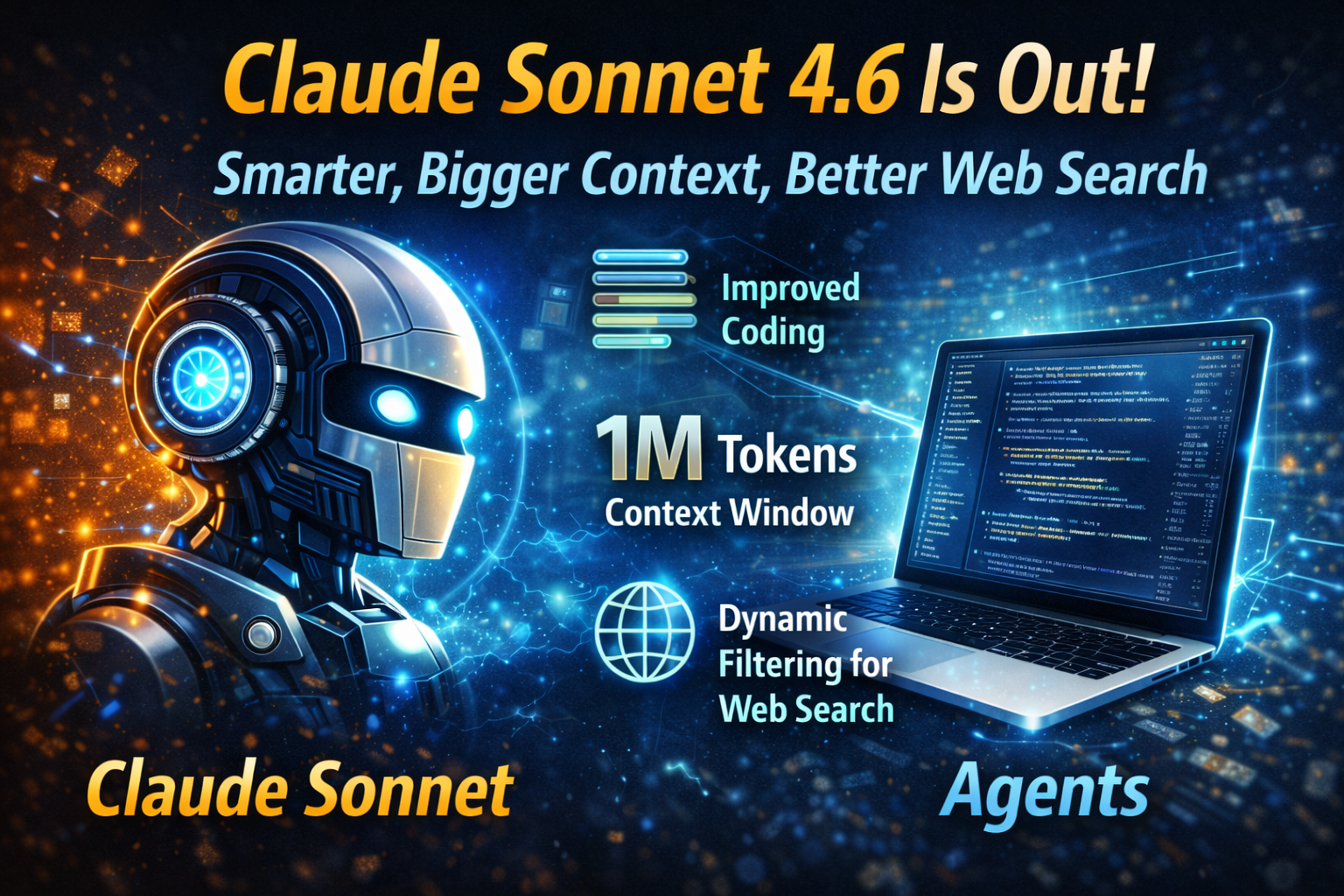
On February 17, 2026, Anthropic released Claude Sonnet 4.6 - and it’s not a small iteration. Sonnet is the “workhorse” tier in the Claude lineup, but this release pushes it closer to “premium model” territory while staying in the cost-efficient lane.
If you’ve been using Sonnet 4.5 for everyday coding, writing, and business tasks, Sonnet 4.6 is positioned as a direct upgrade across the board: coding, long-context reasoning, agent planning, and especially “computer use” (UI automation).
What’s new in Sonnet 4.6 (the headline list)
1) It’s now the default model for Free + Pro users
Anthropic made Sonnet 4.6 the default model inside Claude for Free and Pro plans (including Claude Cowork).
2) 1M token context window (beta)
Sonnet 4.6 ships with a 1 million token context window in beta, aimed at workflows like “load a big repo,” “analyze a long contract,” or “work through multiple documents without constant refeeding.”
3) Pricing stays the same as Sonnet 4.5
Anthropic says Sonnet 4.6 pricing remains the same as Sonnet 4.5, starting at $3 / $15 per million tokens.
4) Big upgrades to “computer use” (agents operating UIs)
Anthropic continues to push “computer use” (agents that can click/type/navigate like a human). The Sonnet 4.6 announcement explicitly calls out major progress here, with examples like complex spreadsheets, multi-step web forms, and working across browser tabs.
5) Tooling got better on the developer side too
Alongside the model release, Anthropic shipped product/tool upgrades: adaptive thinking + extended thinking, context compaction (beta), better web search + fetch, and several tools moving to general availability.
Why this release matters: “Sonnet is catching up to premium”
Anthropic is openly framing Sonnet 4.6 as the point where you don’t always need to “reach for Opus” to get high-quality results.
They say early users often prefer Sonnet 4.6 over Sonnet 4.5 (and sometimes even over Opus 4.5) because it’s less prone to overengineering, better at instruction-following, and more consistent over long sessions.
The big idea is simple:
Sonnet used to be the “fast, cheaper model”
Opus used to be “the serious one”
Sonnet 4.6 is trying to compress that gap.
Computer use: the most “real world” upgrade
Most automation breaks down because real businesses run on:
internal web dashboards
admin panels
old legacy software
sites without clean APIs
Anthropic’s “computer use” approach is meant to handle those messy surfaces without custom integrations - the model can literally interact with software the way a person would.
That matters for:
QA / testing flows (visual checks, form validations)
back-office ops (copy/paste workflows, reconciliation steps)
browser-based automation across tools you already use
Microsoft’s own writeup about Sonnet 4.6 in Microsoft Foundry leans hard into this: they highlight strong OSWorld-Verified performance and browser automation across “tools with no API, legacy systems, and sites you’re already logged into.”
The underrated upgrade: web search now filters itself (dynamic filtering)
On the same day (Feb 17, 2026), Anthropic/Claude shipped an important improvement to web search: dynamic filtering.
The short version:
Instead of pulling huge pages of HTML into the model context and reasoning over everything, Claude can now write and execute code during web searches to post-process results, keep only relevant parts, and discard the rest.
Why that’s a big deal:
Web search is token-expensive
Raw HTML is noisy
Noise hurts accuracy
Anthropic reports that dynamic filtering improved performance by about 11% on average while using 24% fewer input tokens across two benchmarks (BrowseComp and DeepsearchQA).
They also shared concrete benchmark jumps, for example:
BrowseComp: Sonnet 4.6 improved from 33.3% → 46.6%
DeepsearchQA: Sonnet 4.6 improved from 52.6% → 59.4% (F1)
And it’s expected to be on by default for the newest web search + fetch tools when using Sonnet 4.6 and Opus 4.6 on the Claude API.
For devs building research-heavy agent workflows, this is one of those upgrades that quietly changes everything: higher accuracy, fewer tokens wasted, and less “garbage context” poisoning the answer.
Where Sonnet 4.6 is available (and why that matters)
Anthropic says Sonnet 4.6 is available across:
Claude plans
Claude Cowork
Claude Code
the API
major cloud platforms
Cloud rollouts happened immediately:
Amazon Bedrock announced Sonnet 4.6 availability the same day, pitching it as strong across coding, agents, and high-volume knowledge work.
Microsoft Foundry also announced Sonnet 4.6 availability, emphasizing large context, adaptive thinking/effort controls, and enterprise workflows at scale.
This matters because it signals Sonnet 4.6 isn’t just a “chat upgrade” - it’s being positioned as an enterprise-ready model for production agent systems.
Practical use cases (what Sonnet 4.6 is actually good for)
Here are real examples where this release is likely to feel different in day-to-day work:
1) “Big repo” coding without constant refeeding
Load a large portion of a codebase + architecture notes + standards, then do:
multi-file refactors
migration planning
bug hunts across modules
consistent implementation across a design system
That’s the “1M context window” promise.
2) Agentic coding workflows (plan → act → verify)
Use Sonnet 4.6 as:
the “main dev agent” that writes code + explains tradeoffs
a “review agent” that checks diffs and hunts edge cases
a “QA agent” that runs through UI flows (computer use)
Anthropic and ecosystem partners explicitly highlight multi-step reliability and long-session consistency.
3) Browser automation for legacy workflows
Think:
“log into this admin panel”
“update these records”
“download this report”
“upload to another system”
“confirm completion”
This is exactly what “computer use” is targeting.
4) Research-heavy tasks with better signal-to-noise
With dynamic filtering, a research agent can:
run multiple queries
fetch sources
extract only relevant sections
keep context clean
produce more accurate summaries with fewer tokens
That’s the core benefit of “web search that writes code to filter results.”
5) Knowledge work at scale
This includes:
summarizing large doc sets
structured reports
business documentation
“turn this messy data into a clear narrative”
Microsoft and AWS both frame Sonnet 4.6 as strong for high-volume professional workflows (including spreadsheets/analysis).
Bottom line
Sonnet 4.6 is a classic “default model becomes premium-adjacent” release:
bigger context (1M tokens beta)
stronger coding consistency
better computer-use automation
smarter web search (dynamic filtering + code execution)
tooling improvements that make agent workflows more viable
If you build products, internal tools, or automation systems, the most important takeaway is this:
Sonnet is no longer “the cheaper Claude.” It’s increasingly the model you can run at scale and still trust for real work - especially when paired with better tools and safer agent workflows.