
How to Find a Good Shopify Developer (And Why “Knowing Shopify” Is Not Enough)
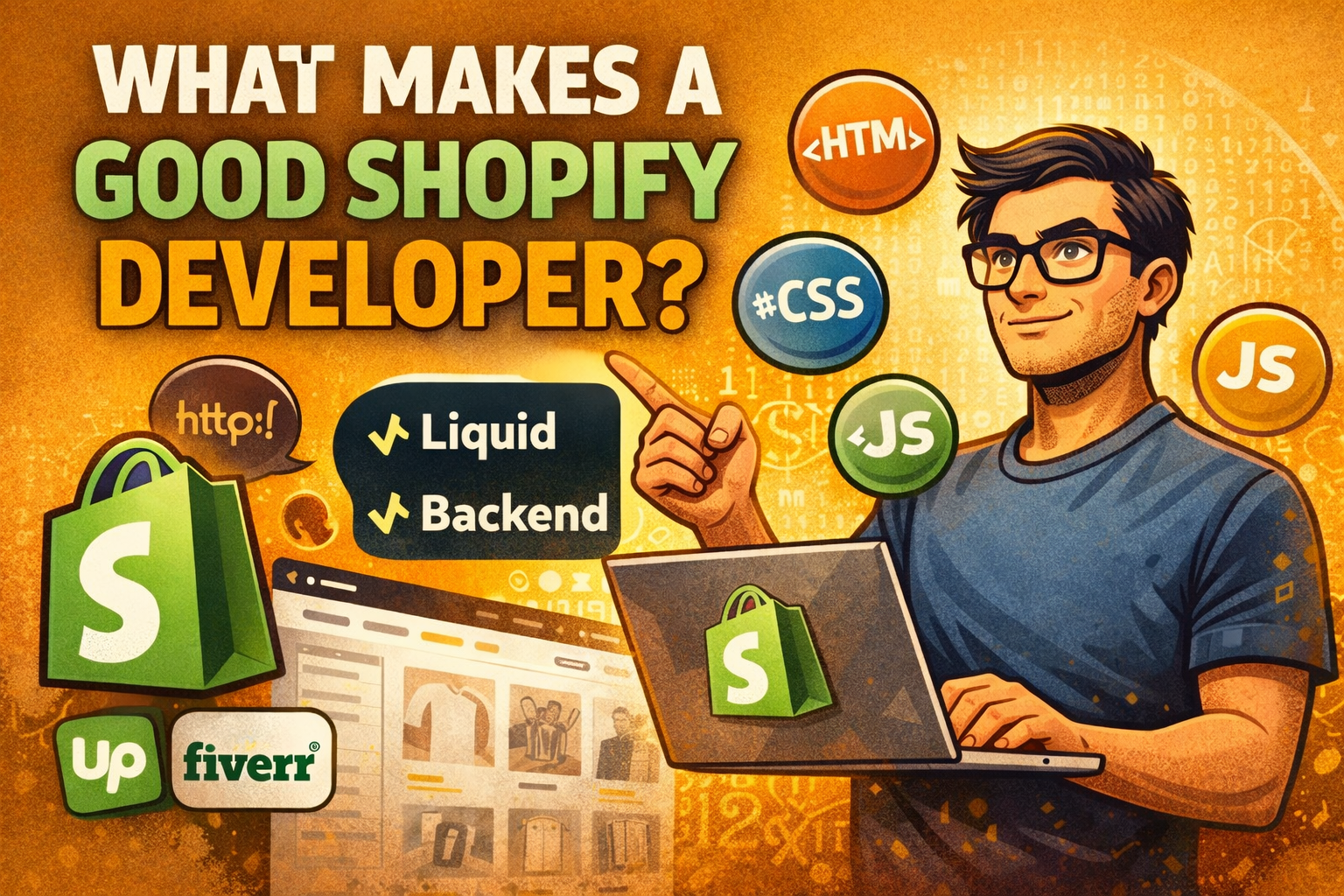
The common misconception: “Shopify developer” = “knows Shopify”
Many business owners assume a Shopify developer mainly needs to know Shopify’s admin and settings.
In practice, it’s almost the opposite.
Shopify knowledge is the final layer.
The foundation is front-end development — because most Shopify work (especially themes and storefront UX) is literally web development.
If you hire someone who only knows where buttons are in Shopify, you’ll often get:
a store that looks okay but feels off,
slow pages,
broken layouts on mobile,
messy workarounds,
or a theme that becomes impossible to maintain.
What is a CMS (and why it matters)?
Shopify is a CMS — a Content Management System.
A CMS is software that helps you manage content (products, pages, images, blog posts) through an admin panel, while the website visitors see is generated from web technologies like:
HTML (structure)
CSS (design/layout)
JavaScript + DOM (interactions, dynamic behaviors)
Shopify is “opinionated” and e-commerce focused — but at the end of the day, the storefront your customers use is still a web app.
Why a great Shopify developer is 95% front-end
For theme development, the work is mostly:
layout (sections, grids, spacing, responsiveness),
typography,
product cards, collections, filters,
cart behavior, upsells, bundles,
performance and accessibility,
visual polish and consistency.
That’s front-end.
Shopify-specific knowledge then sits on top:
Liquid templating (Shopify’s theme language),
theme structure (sections, snippets, templates),
Shopify objects (product, cart, collections),
app integrations and compatibility.
And then there’s a small “sprinkle” of back-end thinking:
data flows (how product data is structured),
API basics (Shopify Admin API / Storefront API in advanced builds),
webhooks or middleware in more complex stores.
You don’t need a full back-end engineer for most Shopify projects — but a developer who understands the concepts avoids fragile solutions.
Why clients often get disappointed (Upwork/Fiverr reality)
On platforms like Upwork and Fiverr, job posts commonly say:
“Need a Shopify developer.”
That’s totally reasonable — it’s not the client’s job to know the technical breakdown.
But the marketplace label “Shopify developer” is broad, and it mixes:
Shopify operators (good at admin + page builders)
Theme developers (Liquid + front-end)
Front-end engineers (strong UI/UX + performance) who also know Shopify
Full-stack commerce devs (headless, APIs, custom apps)
If you accidentally hire #1 for a #2 or #3 problem, you might get a “finished” site that:
feels generic,
loads slower,
breaks when you change content,
or becomes a pile of quick fixes.
That’s how disappointment happens.
The page builder confusion: when you need code vs when you don’t
A lot of store work can be done with:
Shopify’s theme editor,
page builders,
prebuilt sections,
apps.
And that’s fine — when your needs match the builder’s assumptions.
But here’s the key truth:
Page builders still output code.
They generate HTML/CSS/JS — it’s just produced through a UI.
So if you need something more precise:
a layout that perfectly matches your brand,
a complex interactive section,
better performance,
custom logic for product pages,
cleaner responsive behavior,
…manual code can be better because:
it’s tailored to your store,
it avoids heavy “builder bloat,”
it’s easier to optimize,
and it gives you cleaner long-term maintainability.
Builders are designed for general scenarios.
A real developer can build your scenario.
How to choose the right Shopify developer for your project
Think in terms of the type of work you need:
A) You mainly need “store setup” (good fit for builder + admin skills)
Choose someone strong in:
Shopify setup, products, collections, shipping, taxes
theme configuration
basic sections and page builders
standard apps
Ask for: examples of stores they configured and maintained.
B) You need theme customization and a premium storefront
Choose a developer with:
strong HTML/CSS/JavaScript
Liquid experience
a portfolio showing custom sections and real UI polish
Ask for:
before/after examples,
Lighthouse/performance considerations,
how they handle responsive design and accessibility.
C) You need advanced commerce (custom apps, headless, custom integrations)
Choose someone who can discuss:
Storefront API / Admin API
webhooks
middleware (Node, serverless)
architecture and long-term maintainability
Ask for: similar integrations they built and how they secured/maintained them.
10 questions to screen a Shopify developer (simple but powerful)
What Shopify theme have you customized most recently — and what did you change?
Can you show a custom section you built (not just builder pages)?
How do you approach mobile responsiveness?
How do you avoid slowing down the store with apps/scripts?
What’s Liquid and where does it run?
How do you test changes before pushing live?
Can you explain how Shopify renders a product page (data → template → output)?
What’s your approach to accessibility (buttons, focus states, contrast)?
How do you structure code so the store stays maintainable?
What would you not build with a page builder — and why?
A strong candidate won’t give “buzzword” answers. They’ll explain tradeoffs clearly.
Red flags that usually lead to regret
“I can do anything in Shopify” but no examples of custom code
only shows page builder work
no mention of performance or mobile
suggests installing 10 apps for simple problems
can’t explain what Liquid does
pushes changes directly on live theme with no staging/preview
The bottom line
If you want a Shopify store that looks great, feels fast, and stays maintainable:
Hire for front-end skill first.
Then Shopify + Liquid.
Then (when needed) basic back-end concepts.
Because Shopify isn’t magic — it’s a CMS built on the web.
And the storefront is the web.